Excessively boring fusion leaning jazz
album from this Malmö quartet. Most interesting fact
is that drummer Anders Lagerlöf used to be in rowdy garage gods Namelosers in the 60's. Nexus released a couple of more albums in the
80's including one together with Italian trumpeter Enrico Rava, and
made another one 2020. "Nexus" was reissued in Japan in 1978 with a new (and better) sleeve.
Full album playlist
Tuesday, August 6, 2024
NEXUS – Nexus (Four Leaf Clover, 1978)
STÖRNINGEN – I görningen (Subverskivbolaget, 1976)
”I görningen” has a couple of
pretty good tracks like ”Främlingen på Stockholms C”, perhaps
”Det är jag som får tacka” and the towering closer ”Fruset
land”, but it also has a Blå Tåget-styled pastiche and a few
other clunkers dragging the album down. Still, it's better
than some other Uppsala bands on Subverskivbolaget and Piglet, like
Teddybjörn Band and the largely terrible Sub-gruppen (both bands
share members with Störningen). Worth noting is the appearance of
Lars Hollmer on accordeon and vocals. ”I görningen” has its
share of fans, but it's far too uneven for me to recommend it.
Full album
Monday, August 5, 2024
AUTUMN BREEZE – Demo Tapes (MyRecords, 1977-78) / På radio 1978 (MyRecords, 1978)
When record labels failed to show any interested in Autumn Breeze's album ”Höstbris”, they released it themselves in 1979. When they reformed around 2010, they stuck to self-releasing their music, and have now several albums out on their own label MyRecords. But a compilation of demo recordings made in 1977-1978 appeared as a CD-r already in 2009. Alternately entitled ”Demo Tapes” and ”Casette Tapes” (sic!), it features not only early versions of songs ending up on ”Höstbris”, but also tracks that never made it to the LP. Some songs should have; I'd gladly have swapped the dreadful white-boy-in-an-office funk of ”U P A” and the stale disco of ”Ugglans nattvisir” for the eight minutes of ”Nr. 646” off the demo tape. The main difference between the finished versions and those takes are, as you could expect, these are rougher round the edges. Somewhat closer to 70's hard rock, they sound less refined and that's beneficial. And best of all, they don't have those cheesy synths that are all over ”Höstbris”. True those demos have their share of clumsy playing, but what they lose in precision they gain in vividness.
The second archival release, also a CD-r, features a
session recorded for Swedish Radio's local Karlstad branch in 1978.
Those tapes fall somewhere between the '78 demos and the '79 album.
They still sound a bit under-rehearsed with some rather comic fumbles
here and there, and knowing the session would be broadcast, they sound a bit tense.
Swedish Radio has always been famous for
getting a great live sound, but for whatever reason
the fidelity here is peculiarly muddy which obviously is a drawback. I don't know if some
primitive post-production fiddling took place before being released, but there's a
reverb here and there which sounds as if it was added later to cover
up shortcomings on the original tape. Instead it emphasizes them.
Also, the bass must have been boosted prior to release which further
adds to the unbalanced and slightly messy sound.
As you can see, I much prefer the demo
disc. It's not perfect, but it's imperfect in the right way. I'd even
go as far as to say it's better than ”Höstbris” thanks to the
rawness and energy it radiates.
Too bad about the terrible amateurish cover art for both discs though. Somebody failed the Photoshop class...
Demo Tapes/Casette Tapes full album playlist
På radio 1978 full album playlist
Sunday, August 4, 2024
MULLVADSOPERAN – Sånger ur Mullvadsoperan (MNW, 1978)
Mullvaden ('the mole' - don't ask) was an apartment block of four buildings in Stockholm that the city council wanted to tear down already in the 60's. Due to a massive public opinion against the destruction, the houses survived yet another decade, when plans were renewed to knock them down. The tenants refused to move, and became squatters in their own homes in 1977. With the help from Alternativ Stad ('alternative city'), a group working for a more inhabitants friendly city, protests were organised to nationwide attention. Around 300 people took part of the protests and activities, including theatre group Jordcirkus which came together as an immediate result of the Mullvaden protests. Led by Chris Torch, previous with the American group Living Theatre, Jordcirkus performed their 'street opera' ”Mullvadsoperan” released by MNW in 1978, the same year the police eventually stormed the buildings and evicted the tenants/squatters. They lost the houses, but somehow won the moral battle, as the real estate company owning Mullvaden later changed their policies from knocking down old houses then build new (and more expensive) ones, to restoring old buildings in their possession.
A live recording (made at the Museum of Modern Art in Stockholm), ”Sånger ur Mullvadsoperan” sounds like a typical political album of the era, sloppily recorded with too many people singing at once with their fists waving in the air. Some songs could possible have been OK had they been more worked on, especially the first track ”Vintern är kall” which has a sweet waltzing melody that, like everything else here, is shouted to death by the many zealous voices.
Albums such as this always seem to end
up a time capsule, a moment frozen in time, which only looks more
naive and embarassing as the years go by. Although I can easily
sympathize with the sqautters intentions (take care of the old
buildings instead of raising new ones people can't afford to live
in), it doesn't necessarily make for listenable music. The story
surrounding the album is so much more interesting than what's on it.
Full album
Saturday, August 3, 2024
HARAMBEE – Harambee (Odeon, 1971)
This is an album I've wanted to hear for a very long time and curiousity grew to expectations, and that's not good. The higher the expectations, the greater the disappointment. I guess we've all been there.
What I expected to get was a an album of well-crafted pop songs still under the influence of the 60's, with pronunced psychedelic elements. Something along the lines of Jason's Fleece perhaps. But it's not really the lost popsike masterpiece I had envisioned my over-vivid, hopeful mind.
It's a mellow album with pastoral touches and a rich use of harmony
vocals. The album has an underground feel being recorded at home, but
it's surprisingly professional sounding. The songs are
on the commercial side, but not without surprises. There's a fuzz
guitar breakout here, a sharp turn there, and oops! a sudden melodic
twist I wasn't prepared for! There's something about the album that
makes me think of a more consistent Cymbeline, perhaps even
a dash of pop-minded Latin American bands such as Laghonia/We All Together and Embrujo.
Not everything here is good – ”Kalle Wall” is plain embarassing – but as my false expectations waned off, I began to hear the album for what it is, and there are indeed worthwhile moments. The fuzzed ”Regn” is a high point, while ”Tu-ru-tu” sounds like a lost, early solo McCartney demo. ”Harambee” isn't a lost treasure but it has grower qualities, and if you approach it with fewer misguided anticipations than I did, it's not impossible at all that you reach into it much quicker than me.
Harambee made a second album in 1975 as Wasa, a much more commercial (and inferior) pop affair released on Polar Records and produced by Benny Andersson, Björn Ulvaeus and ABBA producer Michael B. Tretow.
Full album
Friday, August 2, 2024
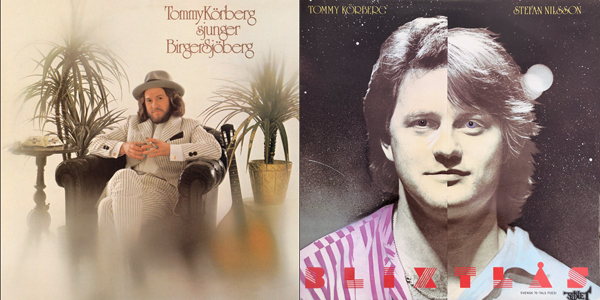
TOMMY KÖRBERG – Sjunger Birger Sjöberg (Sonet, 1974) / TOMMY KÖRBERG & STEFAN NILSSON – Blixtlås (Sonet, 1979)
Tommy Körberg is a huge star even
internationally thanks to his appearance in the ”Chess” musical.
He's an incredibly versatile performer and a massively gifted singer,
but he can also be massively boring and his vocal precision can make
him sound cold. Most of his solo works are way outside of progg; his
relevance to this blog mainly extends to his recordings with Solar Plexus and Made In Sweden. ”Tommy Körberg sjunger
Birger Sjöberg” fits despite not really being progg as it's really a
Solar Plexus album in disguise, featuring the entire band minus
Jojje Wadenius. The songs are musical adaptions of Swedish
turn of the century poet Birger Sjöberg, As expected with the people
involved, it's a well performed affair. It's very polished, so
polished it's lifeless. There's little or nothing of Solar Plexus's
usual frivolous approach to musical genres, and the general feel is that of
restrainment and control. The three tracks that rise slightly above
the inherent dullness are ”Släpp fångarne loss”, ”Samtal om
universum” and ”Bleka dödens minut”. They have vague strains
of a suppressed unease if you listen closely – very closely – but
still lack the spirit the album is in such great need of.
Tommy
Körberg returned to Swedish poetry as a source for inspiration five
years later, but his approach was vastly different on "Blixtlås" (subtitled "Svensk 70-talspoesi", 'Swedish 70's poetry'). Featured are longtime Körberg cohort Stefan Nilsson (Kornet, De Gladas Kapell, Hörselmat) and other people from mainly the jazz and fusion
legions (plus a harmonica cameo from Mats Ronander). It has a sound I don't like, but the music and
arrangements are still more vivid than on the Birger Sjöberg
album. But ”Blixtlås” wasn't made as a companion piece, and
taken as a singular work, it simply sounds lika a cold, cerebreal and
clinical fusion jazz workout.
Sjunger Birger Sjöberg full album playlist
Blixtlås full album playlist
Thursday, August 1, 2024
BLOND – The Lilac Years (Fontana, 1969)
”The Lilac Years” is essentially
the final Tages album minus Tommy Blom who left the band in 1968 for
a short-lived and not very successful solo career. Blond was an
attempt of the remaining members plus new recruit Anders Nordh (King George Discovery, Life, Bättre Lyss, Figaro) to establish a career
outside of Sweden (hence the name change), with the album released in
such diverse territories as the U.S. (with altered sleeve design, see below),
the Netherlands, the U.K., South Africa and New Zealand.
While retaining their melodic sensibilities refined during the Tages years, their long-time producer Anders ”Henkan” Henriksson provided them with a heavier sound as on ”This Is Mine”, ”I Pick Up The Bus”, the storming ”Six White Horses” and the album's proggiest track ”Caroline”. Some sunshine pop drags the album down a bit, but when they go baroque pop on ”There's A Man Standing In The Corner” and the melancholic ”(I Will Bring You) Flowers In The Morning”, their softer side is utilized to great results. The best track on the entire album is one of those tracks too, ”The Lilac Years”, a wonderful six minute adaptation of the Swedish folk song ”De sålde sina hemman”, also known as ”Emigrantvisa” (and previously recorded by jazz pianist Jan Johansson).
The CD reissue is augmented with four singles tracks including ”How Can I Pray When I Don't Believe” revealing Blond as a band with a heavy rock potential. Also featured is the two part ”Balladen om killen” with Örjan Ramberg on vocals. (Another three songs appear a CD-rom track, from a 1969 TV performance, one a version of ”Caroline” and the other two being covers of The Band and Blood, Sweat And Tears.)
The international launch failed, and
Blond split up in 1970, with some of the members going on to other
big things.
Full album playlist with bonus tracks
'The Weight' (TV performance)
'My Days Are Numbered' (TV performance)
'Caroline' (TV performance)