Monday, July 29, 2024

HARALD ”BAGARN” ANDERSSON, ANNA-LISA GRÖNHOLM & SVEN TJUSLINGS TRIO – Stjärnsmällar och tjuvnyp (Proletärkultur, 1978)


Swedish vocals
International relevance: -

Another leftleftleftwing release from Proletärkultur to go along with compilations ”Stöd de strejkandehamnarbetarna”, ”Hör maskinernas sång”, and albums by Dan Berglund and Maria Hörnelius. The 'star' here must be Harald ”Bagarn” Andersson, a baker, actor and local character who shares the vocal duties with sometime actor Anna-Lisa Grönholm. Unless you count the political message, there's not much progg to expect here. The music is more towards 30's and 40's couplets with that overdone singing style verging on speech. It's otherwise well played and the sound is professional (recorded in Nacksving's state-of-the-art studio) but it's incredibly boring – definitely one of the weaker Proletärkultur outings. It's best left untouched in the cheapo bins where you're most likely to find it.

No links found

Sunday, July 28, 2024

ISILDURS BANE – Lost Eggs (Svenska Unikum, 1994; rec. 1976-1993)


Swedish vocals, instrumental
International relevance: ***

Founded in 1976 and hailing from Halmstad (home of Per Gessle), Tolkien fans and symphonic rockers Isildurs Bane didn't make their album debut until 1984 with ”Sagan om den irländska älgen” ('the saga of the Irish elk'). They weren't entirely unknown then, having recorded a lengthy session for Swedish Radio's slot for live music Tonkraft in 1982. And they'd been recording prior that, as archival compilation ”Lost Eggs” reveals.

Seven of of the tracks herein fall outside the scope of this blog as they were recorded between 1984 and 1994, but the remainder was put to tape between 1976 and 1982. So let's concentrate on them.

I'm not a fan at all of the synthetic approximation of British prog rock somewhere between Jethro Tull and Gentle Giant as presented on ”Sagan om den irländska älgen”, but their sound was most deliberate as proven by these early tapes. Many of their elements were already in place, the mid 70's FM rock guitars, the dated synthesizers, the 'complex' time signatures, the twee vocals and the overall cheesiness. The only difference is that ”Lost Eggs” isn't as cohesive as their proper albums, but that's no surprise as it wasn't recorded as such.

Isildurs Bane nevertheless proved to be a long lasting and well liked unit. They've even released two collaborative albums with prog master Peter Hammill in 2019 and 2021 respectively.

Full album playlist (Bandcamp)

Saturday, July 27, 2024

BERNDT EGERBLADH - Nybyggarland (Sonet, 1973) / Kristallen den fina (CBS, 1975) / African Suite (Sonet, 1976)

Swedes of certain generations probably remember Bernt Egerbladh hosting a couple of TV series in the 70's and 80's, in which he interviewed other people and remembered his own past. Perhaps it would surprise those that Egerbladh makes an appearance here on this blog.

He was a noted jazz pianist long before the TV series with a discography going back to the early 60's. His debut on record came in 1962 with ”Fanfar!”, an album split with Lasse Lystedt Quintet. Egerbladh favoured a lyrical tone in the Jan Johansson tradition, but he also harboured pronunced modernist leanings early on, as demonstrated on the 1965 title track from ”Schizo”, his first album of his own. His solo output is surprisingly slim, but he was a beloved session musicians, playing on records by and/or writing music for Doris, Gimmicks, Heta Linjen, Ann-Kristin Hedmark, Rune Andersson, James Hollingworth, and Lill Lindfors. Some of these names may not mean much to a non-Swede, but they present a wide span of musical styles and interests. One of his best known tracks is ”You Never Come Closer” on Doris's sole album, a magnificent slice of uneasy fringe psychedelia. Considering his variety as songwriter as well as performer, this progg blog feature may not be that surprising at all. Egerbladh – who died in 2004 – was a curious explorer happy to take part in projects way outside the jazz world that fostered him.

Nybyggarland (Sonet, 1973)
Instrumental
International relevance: **

With all the tracks adapted from folk tunes of Northern Sweden, it's easy to see ”Nybyggarland” as a modernization of sorts of Jan Johansson's massively successful ”Jazz på svenska” released almost ten years earlier. But ”Nybyggarland” has a wider sound palette with Ulf Andersson (EGBA, Feta Heta Linjen) and Ahmadu Jarr on congas. The album starts out cunningly straight, but by the third track ”Vaggvisa från Norrbotten”, things are getting slightly strange. A foreboding organ creeps into one channel, a cembalo sounding instrument searches tinkling for a home in the other. About halfway in, the piano goes off into unpredicted terrain, as if it breaks free from the melodic centre and breaks up into modal streams. 

The melody of the title track is more like a suggestion of what to come, and soon gives way for a bass riff that establishes a strange moving rhythm building up to a mysterious, almost Arbete & Fritid-like bounce. The albums really goes off the rails with the next track ”Ja, kom då!” where Ulf Andersson's flute leads the way into a gurgling, pulsating and flat out trippy haze deepened by Egerbladh's druggy organ competing with his almost Mwandishi-styled electric piano. The album sort of withdraws a bit after that, but it has one surprise left, ”Hjortronmyren”, with a simple and persistent horn riff fleshing out Ahmadu Jarr's conga beat.

There's nothing bad on this album, but had the entire disc been like those three tracks I've singled out, this would have been a full-on masterpiece. Now, it's a good, maybe even great, album with some truly out-of-the-ordinary moments.


Kristallen den fina
(CBS, 1975)
Instrumental
International relevance: **

”Kristallen den fina” works as a sister volume to ”Nybyggarland” insofar it's built around Swedish traditional tunes; only two tracks are original compositions but they retain a very folky feel and thus slip seamlessly into the program. The title track will be familiar to some readers as both Harvester and Made In Sweden used the melodic theme to their own ends. This version features what may sound like Jojje Wadenius singing along with his guitar in his typical fashion, but the guitarists here are Jan Schaffer and Jan Tolf (Egba, Häxmjölk). ”Barkbrödlåten” in turn is one of the high points on Kebnekaise's second album, and it's a stand-out also in this collection, largely because of Schaffer's really freaky guitar work. (Or is it Tolf messing about? Hard to tell, but it sounds more like something Schaffer would do.) It's also the track in this collection most likely to appeal to the average progg listener. Apart from that track, this album isn't as bonkers as the best stuff on ”Nybyggarland”, but it's a highly enjoyable album with very fine solo and ensemble playing. The folk material is strong and typically melancholic, and well suited for the careful jazz treatment represented here.


African Suite
(Sonet, 1976)
Instrumental
International relevance: ***

Anyone expecting more of that bittersweet wistfulness of the two previous albums will be sorely disappointed with ”African Suite”. As the title say, this time Egerbladh looked to Africa for inspiration. It's a far more rousing experience than any of the preceding albums, and it's also the one overall closest to progg if you by progg mean Archimedes Badkar, Bitter Funeral Beer Band and Spjärnsvallet. (Christer Bothén's 1983 ”Trancedance” album with Bolon Bata also leaps to mind.) This demanded a larger ensemble, so Egerbladh drummed up an all-star line-up including several progg celebrities such as Ahmadu Jarr (again), Stefan Brolund (Egba, Oriental Wind, Pop Workshop), Lennart Åberg (Rena Rama, Häxmjölk, Bengt-Arne Wallin), and Malando Gassama (Ablution/Baltik, Häxmjölk). ”African Suite” is, for some reason, more cohesive than the other two in this trio of albums, which isn't to say it's at all samey -- on the contrary, it's a varied collection of tracks. The two I like the most are also the two most jubilant ones, ”Welcome To The Gambia” and ”Fire Dance”. Well, maybe I should mention the forceful ”Worksong” too, with its compelling beat constantly pushing forward relentlessly. But there really aren't any weak moments here. It helps though if you already like the African leanings of the abovementioned bands. If you do, this will be a nice discovery if you haven't heard it already.

Nybyggarland full album playlist
Kristallen den fina full album playlist 
African Suite full album playlist
Friday, July 26, 2024

ANDERS CARINGER – Valfrid (Wisa, 1975) / Cellstoff (Wisa, 1977) / Du nya du fria (Wisa, 1981)


Swedish vocals, English vocals
International relevance: **

A rather extensive curriculum vitae he has, that Anders Caringer: author, music and drama teacher, educationalist, crossword maker, pastor and prison chaplain, not to mention having been a musician since the early 60's when playing with various bands unknown to most. And then, releasing a mere three albums between 1975 and 1981 before returning as a recording artist in the mid 00's with another two albums (one being a three-CD box set). He's still active.

He made his album debut in 1975 with ”Valfrid”, credited to Anders Caringer and Bland Andra (meaning 'and others'). It's one of those albums that sounds unexceptional at first but appear a bit skewed when you listen closer, like some Christian 70's albums can be - the songs aren't simplemindedly linear and have quite a few unexpected harmonic turns. The style is basically singer/songwriter folk with religious and political concerns, but none of it too much in your face. The sound is predominantly acoustic with congas and harmony vocals, but you can spot an electric wah-wah guitar here and there. ”Verklighet” even has a full band and an off-kilter rhythm that falls somewhere between undeveloped reggae, semi-gospel and misunderstood funk ending up like nothing of it. Perhaps the track that best captures the underground feel that permeates the entire album. The real standout track however is ”Glädje”, an oddly lilting number with a softly soaring melody that expands and contracts, following its own path to a hypnotic jazz waltz rhythm. Definitely one hidden gem of a track!

”Cellstoff” followed in 1977 and has a very different sound provided a number of musicians including studio bassist Backa Hans Eriksson and the guitar work of Tomas Ernvik on a little less than half of the LP. Ernvik is particularly evident on ”Degdag” where his bizarre chords and chopped-up guitar fills perfectly emphasize the ominous mood of the track. Another successful track is opening cut ”Identitet” that features a quirky, jazzy piano solo that seems chase the restless beat down the road and out of town. ”Cellstoff” isn't as consistent as ”Valfrid”, but these two tracks are unusual enough to demand a listen.

1981's ”Du nya du fria” has a long list of credits but it's the sparsest sounding disc in this lot. The sound is skeletal but despite a small ensemble of wind instruments here and there. The bare bones production pushes Caringer's voice and religious/social/philosophical reflections to the fore. The songs have fewer peculiar twists this time, and while most songs are well written enough they're generally more ordinary than on Caringer's previous outings. The best track is also the most subdued one; ”Simons sång” is a heartfelt but somehow brooding song to a newborn child.

I think Anders Caringer is one of the more interesting Swedish Christian singer/songwriters I've come across. Not all here is great, but there are indeed more than worthwhile moments, even flashes of brilliance. You could easily put together a very good, LP length compilation of the best moments from these three albums. With the current upsurge of interest in the Swedish Christian music scene of especially the 70's, I think the time is ripe for a general Caringer (re)discovery.

Valfrid full album playlist
Cellstoff full album playlist
Du nya du fria full album playlist

Thursday, July 25, 2024

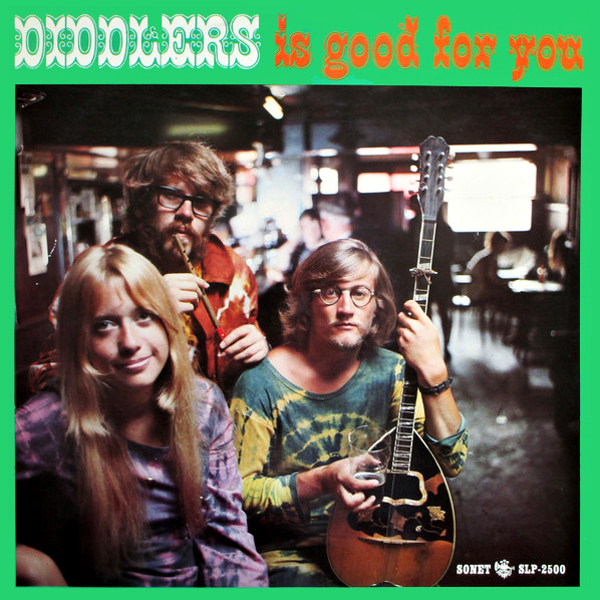
DIDDLERS – Is Good For You (Sonet, 1969)

English vocals, Swedish vocals, other languages
International relevance: *

An early incarnation of folk band Låt & Trall, and more interesting from a historical point of view than a musical one. Musicwise it's straight-laced folk music with a very strong Irish bent. This may be 1969, but these days you can go to any local fake 'Oyrish' pub and hear exactly the same thing you hear on this album, complete with a mock accent put on for 'authenticity'. It works best when the always genuine Marie Selander takes the lead, as on the best cut ”Go To Sea Once More”.

Selander is one of the participants who later got an artistically rewarding career. Add to that Urban Yman who went on to Blå Tåget and the various Träd, Gräs & Stenar incarnations. The ever present master musician Kjell Westling was also a member of Diddlers, as were Pyret Lindström and Slim Lidén who both joined Freedom Singers a few years later (along with Selander).

By the way, shouldn't it be "ARE" instead of "IS" in the title?

Full album playlist

Wednesday, July 24, 2024

JOHAN PETRÉN – Bevingade ord (Spegling, 1982)


Swedish vocals
International relevance: **

With too many people carelessly throwing the word 'pretentious' around for anything they don't understand, let's see what the Oxford Dictionary has to say about the word:


pretentious adjective
/prɪˈtenʃəs/
(disapproving)

trying to appear important, intelligent, etc. in order to impress other people; trying to be something that you are not, in order to impress

Johan Petrén is a Gothenburg local singer/songwriter who released two albums, ”Bevingade ord” in 1982, and ”Ut i det blå (Sånger från Scilla)” in 1995. He emphasizes his lyrics and this is where 'pretentious' comes in. He has literary ambitions, but many of his wordings come off as cringeworthy. Like many a self-aggrandizing writer, he has a way of making banalities sound VERY IMPORTANT when they're in fact not, further emphasized by his somewhat pompous way of singing.

But Petrén is in fact an otherwise good songwriter. Some songs here are simply great, such as album opener ”Du är alldeles unik” with an lilting drive and an irresistably melancholic melody laced with the windy wooden sound of Maria Apelmo's simple but very effective recorder. ”Och floden fortsätter flyta” is the second best track in this lot and another perfect slice of Petrén's melodic talent.

”Bevingade ord” is – to the best of my knowledge – one of only three LP's released by the Spegling label (the other two being a classical record and a choir album). Their ambition was to record music unaffected by excessive production; they strived for a natural sound. The sparse instrumentation – the acoustic guitar, the flutes, the electric and acoustic basses etc – sounds full and rich and very inviting.

I oftentimes say that a dimension is lost on listeners who don't know the Swedish language, but in this case, it's quite the contrary. The lyrics are indeed the weakest link in Petrén's songs, so I'd say you're much better off not understanding them. That makes the songs stand tall on strictly their musical terms. While Johan Petrén carves out a slightly personal niche, I believe fans of (a much less lyrically talented) Kjell Höglund and (a much less political) Dan Berglund very well might love this.

There are lots of unreleased songs on Johan Petrén's Youtube channel, some dating back to the early 70's.

Tåglåt från Hestra
Ödets tärning
Visa till min käraste
Utan nån skugga
Och floden fortsätter att flyta

Tuesday, July 23, 2024

BJÖRN ARAHB – Jag är en bekymrad socialist (YTF, 1974)


Swedish vocals
International relevance: *

Björn Arahb was a visa singer (to remind you, visa is a certain kind of Swedish singer/songwriter music) that made handful of albums in the 70's and early 80's. 

Released in 1974, it's made up by songs written and released by the #1 visa singer Cornelis Vreeswijk. Several jazz and prog alumnis back him up, including Wlodek Gulgowski, Sabu Martinez, Jan Bandel and Luis Agudo (Energy). Lorne de Wolfe of Contact designed the album cover. Together they work up a funky groove on some tracks – try for instance ”Telegram for Lucidor”, ”En visa till Ellen när hon hade flyttat hemifrån” or ”Ågren”. Thing is, you can get it too from Vreeswijk's own albums around 1969/70, and better. And as Arahb tries hard to mimick Vreeswijk's special way of phrasing, ”Jag är en bekymrad socialist” comes off as a redudant work of a lesser copycat. The album is of course meant as a tribute but it falls flat compared to the original.

Full album playlist