Showing posts sorted by relevance for query jan bandel. Sort by date Show all posts

Monday, February 9, 2026

EMPHASIS ON JAZZ – Tabaruzaka (Four Leaf, 1980)

 
Instrumental
International relevance: **

Emphasis On Jazz were a sort-of supergroup in the jazz field, founded by ex-Gimmicks reed player Urban Hansson along with Berndt Egerbladh in the mid-70s. Completing the line-up on this their first proper Emphasis On Jazz album were well credited drummer/percussionist Jan Bandel, bassist Thomas Östergren (ex-Barabbas and sometime member of Oriental Wind), and drumming Icelander Pétur Östlund (Communication and once an original member of Icelandic 60s band Thor's Hammer whose ”I Don't Care” has become a freakbeat classic).

”Tabaruzaka” is lightly fusion indebted contemporary jazz with Japanese shadings. It's not particularly memorable as a whole, but it has some nice textures mainly thanks to Jan Bandel's Celtic harp, vibraphone and tablas. I also must say that Thomas Östergren's fretless bass is surprisingly well applied – it's an instrument I'm not too fond of otherwise.

 
Emphasis On Jazz made one further album in 1984. Fittingly enough, a Japanese pressing of ”Tabaruzaka” also exists, housed in a much better cover (see above).

Full album playlist

Saturday, July 14, 2018

HAWKEY FRANZÉN – Complete albums 1969-1981

Hawkey Franzén was a member of Lea Riders Group who made a couple of 45's in the 60's, including the rousing ”Dom kallar oss mods” which became an international garage psych classic when included on the third volume of the groundbreaking compilation series ”Pebbles”. He performed in the Swedish version of ”Hair” at Scalateatern in Stockholm in 1968, and joined Jason's Fleece for their one-off album in 1970. He released several singles with various line-ups and appeared on albums by Björn J:son Lindh, Lena Granhagen and Fred Åkerström; translated lyrics and wrote songs for Monica Törnell, Tommy Körberg, Anita Lindblom, Sylvia Vrethammar... The list of domestic stars he's worked with is virtually endless. His solo album discography is far more comprehensible. Between 1969 and 1981 he released a mere four regular LP's, plus two children's albums.

Visa från Djupvik (Mercury, 1969)
Swedish vocals
International relevance: ***

Hawkey Franzén spent a month in jail for draft dodging and there he met Björn J:son Lindh who was behind bars for the same reason. Together they began working on songs dealing with life in prison. The collaboration spawned Franzén's first solo album ”Visa från Djupvik”, with Djupvik being the name of correctional institution where they were interned. Tracks such as ”Tillbaka från skogen” and ”Vakuum” bear a slight Pugh Rogefeldt resemblance, and there's a disctint jazz influence on ”Somnar” and ”En dag”, but the best tracks are ”Tack ska ni ha!”, ”Fångvård” and the brass laced ”Tyst”. Fans of Lea Riders Group might find ”Visa från Djupvik” disappointing but it's a very fine album in its own right.

Visa från gungor och sand (MNW, 1971)
Swedish vocals, instrumental
International relevance: ***

”Visa från gungor och sand” – subtitled ”Visa från världens största park”is a children's album of sorts, a bit like Jojje Wadenius' ”Goda' goda'”, but it's as much an album about children as it's for children. ”Varför då” is a good song, ”Gungor och sand” shows a minor David Crosby influence, and the instrumental jam based ”Två pappor” that ends the album is OK too, but the children singing back up vocals on several of the tracks are a bit distracting. And the lyrics just don't have the urgency of those on ”Visa från Djupvik”.

Visa från och till (Mercury, 1971)
Swedish vocals, instrumental
International relevance: ***

A move back to major label Mercury after the short stint with MNW for ”Visa från gungor och sand”. ”Visa från och till” has a somewhat more detailed production including moog and strings, but it falls a bit short songwise. Franzén occasionally comes off like a Cornelis Vreeswijk (very famous Dutch born Swedish singer/songwriter) wannabe on a couple of tracks and a sleepy eyed Mikael Ramel on others. But it has a couple of interesting moments. ”Jag ger mig” has a driving groove; the short Bela Bartók composition ”Ungersk polsterdans” wouldn't have been out of place on a Samla Mammas Manna album, and the two versions of ”Sorgmarsch” are odd and intriguing exercises in unusual rhythms. The best track of them all is however ”Sorgekranser” that further explores 'chopped off' time signatures. To sum it up: ”Visa från och till” is uneven but with worthwhile highlights.

Visa av och med (Viking, 1972)
Swedish vocals
International relevance: **

Hawkey Franzén's last proper album for 33 years, and a good one at that. It's largely a contemporary band singer/songwriter album (very atypical to the Viking label) but the performances are solid and Franzén sounds more inspired on this album than he did on ”Visa från och till”. The most progressive track ”Visst kan man bli fast” is splendid with Björn J:son Lindh in excellent (semi-free jazz) flute shape.

”Visa från Djupvik” often gets most of the praise but it might actually be that ”Visa av och med” is my personal favourite Hawkey Franzén album.
 
Skivan om Bubblan som fick nya föräldrar (Proprius, 1973)
Swedish vocals, spoken word
International relevance: *

This children's album isn't really a Hawkey Franzén album but it features him as the story's main character Bubblan's two daddies. The musical parts are performed by Jan Bandel, Jan Schaffer and Stefan Brolund (Hörselmat, Pop Workshop) with jazz musicians Bengt Hallberg, Egil Johansen, Staffan Sjöholm and Rune Gustafsson completing the line-up. The music was written by Leif Strand and is mellow but quirky – sometimes even spaced out. Hardly an everyday spin but peculiarly appealing even during the spoken bits (although they admittedly won't do much to non-Swedes). The plot's written by actor, author and translator Catherine Berg.

Smulvisor & bitlåtar (Sonet, 1981)
with Ulla Wiklund
Swedish vocals
International relevance: *
An album made with Ulla Wiklund who voice acted Bubblan on the previous album. Franzén produced the album, sang on half of the tracks, and provided guitars and sound effects. Other performers include Jan Bandel, Greg FitzPatrick, Ale Möller and Göran Lagerberg. The Oriental sounding ”Gamla trappan” features tablas, bouzouki and flute and is the only interesting track on an uninteresting album.

Visa från Djupvik full album playlist

Visa från gungor och sand full album playlist
Visa från och till full album playlist
Sagan om bubblan som fick nya föräldrar full album
Smulvisor & bitlåtar full album playlist

Tuesday, July 15, 2025

LEIF STRANDS KAMMARKÖR – Complete albums 1969-1982

What's a chamber choir doing here? you might ask. A relevant question for sure, but this isn't just any chamber choir. This lot is far more progressively minded than a whole lot of your standard proggers and the five albums they recorded from the end of the 60s up to the beginning of the 80s have some of the most explorative music of the era.

Leif Strand founded the choir in 1965 while still a student at the Royal Academy of Music in Stockholm which he attended from 1960 to 1970. He acquainted several prominent performers on the jazz field such as renowned pianist Jan Johansson, bassist Georg Riedel and clarinetist/saxophonist Arne Domnérus as well as future progg illuminaries Jan Schaffer and Björn J:son Lindh. These friendships proved crucial to Strand as his recording career took on by the turn of the decade.


En skiva med Leif Strands kammarkör (Proprius, 1969)
Swedish vocals
International relevance: **

The title may be unassuming (=”an album by Leif Strand's chamber choir”) but the music is anything but. Promininently featured are the previously mentioned Riedel and Domnérus along with pianist Bengt Hallberg, conga player Rupert Clementine and Lennart Åberg on soprano sax. Composition credits are split between Riedel and Strand with ”Blowing In The Wind” being the Dylan song in an expansive arrangement signed Jan Johansson (who tragically passed away in a car accident the year before this was recorded). It's not that the jazz elements are just tucked onto the classically styled choral arrangements – the exchange is dynamic and works as a truly cohesive unit that's indeed forward thinking and open-minded. Trad jazzer Arne Domnérus particularly surprises coming out as a true modernist.

This is deeply musical and extensively creative music cut from the same cloth as Carl-Axel and Monica Dominique of Solar Plexus, and it's rather surprising they're not involved on any of these Leif Strand records. They would have been a perfect match.


En skiva till med Leif Strands kammarkör (Proprius, 1970)
Swedish vocals, other languages
International relevance: *

The second album has an equally mundane title (=”another album by Leif Strand's chamber choir”) but a tweaked line-up. The Riedel/Domnérus/Hallberg troyka is intact but augmented by tenorist and flautist Claes Rosendahl, guitarist Rune Gustafsson, and noted Norweigan born drummer and percussionist Egil Johansen. The instrumental assets are unfortunately not sufficiently utilized with the emphasis being on the vocals. Too much to the fore and much too operatic bordering on sprechgesang, they make ”En skiva till” the weakest Strand album for me.The high point is probably 8 minute opener ”Gospel”, a chaotic piece of modernist dissonance and intimidating drama.


Sorgen och glädjen (Proprius, 1971)
Swedish vocals
International relevance: **

The albums here aren't particularly rare (or sought-after), but this is one of the most common. It probably sold better and is a lot more easy-going than the previous album. With many of the songs being traditional material and folk chorals, it's rich with melancholy textures reminiscent of the always popular work of Jan Johansson. Which is not to say it's smoothed out – some parts are certainly moving in weird territories. ”Världens frälsare, kom här” even touches on Oriental scales. It's also the album up to then that most successfully merges the choir and the jazz section. A good entry point for the novice.


Allt under himmelens fäste (Proprius, 1974)
Swedish vocals, English vocals
International relevance: **

Released three years after ”Sorgen och glädjen” (=”the sorrow and the joy”), ”Allt under himmelsens fäste” (=”everything below the firmament of heaven”) follows along the lines of its predecessor but has a stronger emphasis on jazz, occasionally even veering towards post-bop. The traditional “Bergkirstis polska” (arranged by Jan Johansson) almost goes off the deep end entirely!

Visa singer/troubadour Göran Fristorp is a new addition here; the album was released the same year as Fristorp's own album “En luffare är jag” that featured the choir. I'm not too keen on his voice, it's a bit too precious, and his contributions spoil the flow a bit. Still, this is the where to go if you want more after “Sorgen och glädjen”.

 
Missa Pro Pace: En fredsmässa (Europafilm, 1982)
English vocals, other languages
International relevance: ***

A seven year recording hiatus was interrupted in 1981 by a collaborative live album on the dreaded A Disc label, with the Chamber Choir's first proper album in ages appearing the following year. A lot had changed since “Allt under himmelens fäste”. Stahlwarts Riedel, Hallberg et al were gone, substituted by the likes of J:son Lindh, Schaffer, Stefan Brolund and Jan Bandel. The personnel change obviously updated the sound and style, and “Missa Pro Pace” (“a peace mass”) is the most overtly proggish album in this lot. Some sections almost sounds like a light version of French band Magma! It's also the first album to utilize other effects than the natural reverb of the recording location. It's the first Chamber Choir album that sounds produced. “Credo” for instance has space echo flute whereas Schaffer's reverb-laiden guitar in “Agnus Dei” isn't that far removed from Terje Rypdal. Most surprising feature though is the electric sitar and tablas in “Gloria” – I didn't see that one coming!

Once you've gotten used to this being a very different album from what you've come to expect, it's actually rather good. Thinking of it, this might be the best first choice to a lot of people coming from progg even if it's not quite in line with Leif Strand's 'original' chamber choir. Then again, it's as free-spirited as any of their work, and that is after all the most striking and important trait of this decidedly imaginative and largely captivating choir.

En skiva full album playlist
En skiva till full album playlist 
Sorgen och glädjen full album playlist

Allt under himmelens fäste full album playlist
Missa Pro Pace: En fredsmässa

Monday, October 9, 2017

JASON'S FLEECE – Jason's Fleece (Mercury, 1970)

English vocals
International relevance: ***

Jason's Fleece was a supergroup comprising several famous members about to become even more famous in the years following their first and only album.

Singer and guitarist Hawkey Franzén had been in Lea Riders Group immortalized by ”Dom kallar oss mods” in 1967, one of the rowdiest and most psychedelic 45's ever to come out in Sweden, subsequently gaining international notoriety when it was included (with misspelt title) on ”Pebbles Vol. 3”. Franzén also had a solo album out prior to Jason's Fleece.

Flute player Björn J:son Lindh and drummer Jan Bandel were fresh out of Atlantic Ocean who released one highly sought-after album in the same year as Jason's Fleece, ”Tranquillity Bay”. Of course, Lindh had several solo albums out in the 70's, as well as session musician credits on numerous albums.

Made in Sweden main man Georg ”Jojje”Wadenius is another frequent session player – he's played on literally hundreds of albums over the years. He rose to international fame during his stint with Blood Sweat and Tears during the first half of the 70's.

Remarkable bass player Göran Lagerberg has a striking CV as well, including the highly talented ”Swedish Beatles” Tages in the 60's, Kebnekajse, Fläsket Brinner, Tillsammans, Egba, Bolon Bata, and... Well, you get it.

New York born jazz bassist Red Mitchell had an international career as a sideman for everyone from Gerry Mulligan and Clark Terry to Paul Bley and Henry Mancini before moving to Sweden, becoming a stalwart on the Swedish jazz scene.

Singer and guitar player Sam Ellison released the ”Jag vill ha en lessen häst” 7” in 1970 which actually was Jason's Fleece before they adopted the name. The following year, Ellison (whose real name was Elison, with a single L) released an eponymous album, and then became an in-demand session player for a couple of years.

Sax blower Kenneth Arnström was in Handgjort along with Lindh, Bandel and Greg FitzPatrick, and is also on the Tillsammans album (but so is everybody).

With such an illustrious cast, one could expect ”Jason's Fleece” to live up to its reputation but sadly, it doesn't quite. Despite good intentions and great ambitions, the album's a bit too bland second tier pop psych with minor dashes of blue eyed soul. It looks good on paper, but with the possible exception of the Beatles flavoured ”Damn Long Way Behind Us”, the album won't quite take off. Maybe it's a matter of entities cancelling each other out? Maybe they just couldn't muster up enough inspiration once it was time to enter the studio?

Someone who certainly couldn't justify his remuneration was cover designer Göran Rossander. 'Progressive' layout or just a good old lapse of imagination? I'd say the latter.
 
Full album playlist

Saturday, August 18, 2018

GREG FITZPATRICK – Det persiska äventyret (MNW, 1977) / Bildcirkus (Mistlur, 1978)

 
Swedish vocals, instrumental
International relevance: ***/***

Beverely Hills born Gregory Allan FitzPatrick was the son of director and documentary maker James A. Fitzpatrick who began making movies in the 20's and whose career spanned five decades. He left the States in 1966 and spent a year in Finland before settling down in Sweden. He earned his living as a street musician, and eventually formed a band with Jan Bandel and Sten Bergman. They turned into Atlantic Ocean and recorded one album in 1969 (released the following year), then FitzPatrick left for Asia. Upon returning to Sweden, he initiated Handgjort that in turn spawned the Tillsammans project with a line-up large as a small city. In 1976 he teamed up with Samla Mammas Manna for ”Snorungarnas symfoni”. His first solo album appeared in 1977.

”Det persiska äventyret” is an unintentionally funny album. FitzPatrick sings in Swedish – or he thinks he does. With an American accent so thick you could chop bricks out of it to build a house with, it's sometimes almost impossible to understand what he says. You've got to admire his linguistical braveness though, more than the album itself. It's more peculiar than good due to his lack of proper Swedish. For some reason the album has a several cover versions of songs by Hoola Bandoola Band, Bo Hansson/Fläsket Brinner, Stenblomma, Robert Broberg, Gläns Över Sjö Och Strand and Philemon Arthur & The Dung's ”Du var min enda vän”. His passion for Sweden and the then contemporary music is endearing for sure but ”Det persiska äventyret” is actually rather dull apart from the curious pronunciation.

For his second album ”Bildcirkus”, released under his full birthname, he dropped the lyrics altogether in favour of an all instrumental semi-symphonic music that's closer to ”Snorungarnas symfoni” than ”Det persiska äventyret”. His pioneering infatuation with synthesizers shows. He uses them a lot on the album, making it sound dated and sterile. Parts of it remind me of Samla Mammas Manna member Lars Hollmer's solo albums, but ”Bildcirkus” isn't as heartfelt as say ”XX sibiriska cyklar”.

Greg Fitzpatrick later became an in-demand session player, and opened a synthesizer shop in Stockholm in the 80's. He then turned to jingles making for commercials, and he's also worked in the field of music pedagogy.

Det persiska äventyret full album playlist
Bildcirkus full album playlist

Monday, September 17, 2018

MONICA TÖRNELL – Ingica (Polydor, 1972) / Alrik (Polydor, 1973)

Ingica (Polydor, 1972)
Swedish vocals
International relevance: **

Swedish troubadour Cornelis Vreeswijk discovered Monica Törnell in 1971 when she was only 17 years old. Polydor released her debut the following year, an album that reveals Törnell had a surprisingly mature voice despite her young age. The label engaged a stellar cast of studio musicians for the recordings, including Björn J:son Lindh, Jan Bandel, Hawkey Franzén, Janne Schaffer and Vreeswijk himself.

”Ingica” features songs written specifically for the album by Vreeswijk, Carl-Axel Dominique (of Solar Plexus) and J:son Lindh, plus Franzén and Vreeswijk translated covers of Melanie, Eric Anderson and Jethro Tull. The album is in a melancholy folk rock vein with Törnell's raspy voice to the fore. A consistent work, especially for such a young artist as Törnell was at the time.

Alrik (Polydor, 1973)
Swedish vocals, English vocals
International relevance: **

”Alrik” is similar in tone and style to the debut, only with deeper running folk strains. The album uses more or less the same set of musicians, and Törnell herself sounds a bit more confident here, bringing in more songs written by herself than on the previous album. The best track however is the album's first, the traditional ”Öje brudmarsch” with some mean Schaffer guitar.

Ingica full album playlist
Alrik full album playlist

Sunday, June 5, 2022

KLARATEATERN – Sessornas sånger (YTF, 1976)


Swedish vocals
International relevance: **

With music written by Gunnar Evander (and lyrics by Per Lysander and Suzanne Osten), this stands as something of the third part in the informal feminist trilogy beginning with ”Sånger om kvinnor” in 1971 and continuing with ”Jösses flickor – befrielsen är nära” in 1975. While not great, ”Sessornas sånger” stands head and shoulders above the previous two. It's more refined, the perfomances are smoother thanks to seasoned studio pros such as Rolf Alex and Jan Bandel but it's also a bit lacklustre, and the songs are at least occasionally better. Although they originate from a stage performance by Klarateatern, several of them are focused enough to stand on their own, in particular the almost-funky ”Den svarta prinsessan och den röda”, the evocative ”Sessornas magar” and the brooding gospel-tinged ”O Gud gör mig fattig”. ”Äntligen en prins” isn't that great, but fans of wah-wah might appreciate it nevertheless. Some songs have male vocals, but the songs featuring female vocals fare generally better.

Being musical excerpts from a stage play, the songs tell a story, with the plot centered around the Swedish princesses. Given ”Sessornas sånger” was released at the height of progg era, it's critical of the Swedish monarchy. 

All in all, the album's value is greater as a period piece than a musical work.

Comes with a lyric sheet.

No links found

Thursday, July 3, 2025

PIERRE STRÖM – Complete solo albums 1970-1976

Pierre Ström was one of the prime exponents of the wave of Swedish troubadours, or visa singers, in the 60s and 70s that included among others Cornelis Vreeswijk, Fred Åkerström, Thorstein Bergman and Finn Zetterholm. The visa singers rarely went progg full on, but they shared progg's general political sympathies more often than not so there's a loose connection between them.

Ström is already on the blog with ”Joe Hill lever!”, a joint release with Oscar Norrman and Anders Granell. Ström had two more collaborative albums out in the 70s (one with Finn Zetterholm), but this review is for the albums solely credited to him.


I vädurens tecken (Intersound, 1970)
Swedish vocals
nternational relevance: *

After making a sneak debut on a various artists compilation in 1969 and a 7” on MNW subsidiary Green Light, ”I vädurens tecken” was his first full length album. It has it's share of mildly brooding moments but it's generally a more good natured collection than the album cover might lead you to believe. The emphasis on Swedish covers of Tom Paxton, Leonard Cohen and Simon & Garfunkel and the light pop backing sometimes augmented with orchestral arrangements suggest that Ström was more in tune with his times than some of his peers. Pleasant but not hugely exciting.


Pierre Ström sjunger sånger av Leonard Cohen (Intersound, 1971)
Swedish vocals
International relevance: *

The title says ”Pierre Ström sings songs by Leonard Cohen”, and that's exactly what it is, a full disc of translated Cohen songs. Ström never strays far from the original versions, and that perhaps served a purpose in 1971 before the original artist was a household name in Sweden, but 50 years on the album has severely deteriorated into redundancy. The Leslie treated vocals on ”Lavin” (=”Avalanche”) is a nice touch though.

The album was reissued as "Cohen på svenska" (="Cohen in Swedish") by YTF in 1974. 


Rallarvisor (YTF, 1973)
Swedish vocals, a cappella, instrumental
International relevance: *

Two years on and a switch to the visa movement's own label YTF. Still having problems getting original material together, or a lack of interest in such a venture, Ström looked to the traditional songs of the rail layers of old. He obviously felt at home in this material because he sounds much more confident than on his first two albums. The light pop ambitions are gone in favour of a small ensemble consisting of old-timey dance accordeonist Sone Banger, jazz bassist Red Mitchell and folk fiddler Björn Ståbi, giving ”Rallarvisor” a stronger local flavour. A handful of a cappella tracks (or backed with the metallic clang of hammers against railway sleepers) further helps setting it apart from what came before. The problem with thematic albums such as this though is that they can come across as museal, and that goes for this one as well.


På Palmes tid (YTF, 1976)
Swedish vocals
International relevance: **

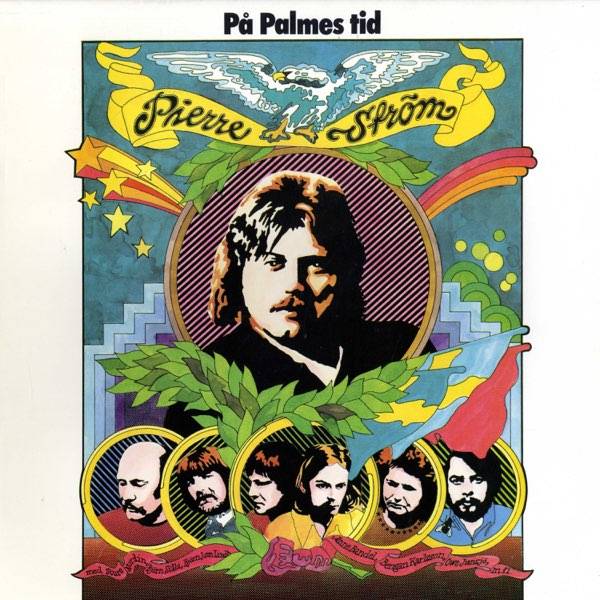
Finally an album of Pierre Ström originals, and a return to fuller arrangements. Banger and Ståbi are still on board, but the personnel's expanded with drummer Jan Bandel (Atlantic Ocean, Jason's Fleece, Baltik and many more), Bengan Karlsson (Heta Linjen, Svenska Löd AB!) and Björn J:son Lindh (but no Schaffer!). It's not as rockish as one could have hoped for though. Ström's songs are closer to the political progg of the day than say, a Heta Linjen groove although both ”Motströms” and ”Solens gyllne lampa” adds a bit of funkiness to the mix. Best track by far is ”En kväll rätt sent”, politically charged but with a slight mysterious mood brought on by Bengan Karlsson's watery guitar sound and bated playing. A must-hear it is not, but Pierre Ström's best album nonetheless, housed in an eye-catching jolie laide album cover.

I vädurens tid full album playlist
Sjunger sånger av Leonard Cohen full album playlist
Rallarvisor full album playlist
På Palmes tid full album playlist

Monday, August 26, 2024

PETER NORDSTRÖM – Ensam och fri (Bastun, 1980)


Swedish vocals
International relevance: *

Little known rock singer/songwriter that worked hard on his Ulf Lundell look on the album cover but sounding more like a lesser version of Swedish country/soft rock singer Lalla Hansson.

Peter Nordström debuted in 1978 with one-off single ”Det kommer nya tider”/”Salongsbolsjeviken” featuring Björn J:son Lindh on piano. He appears on the ”Ensam och fri” album too, plus Kebnekajse's Mats Glenngård, Berndt Egerbladh and a number of seasoned studio musicians such as Jan Bandel, Ola Brunkert and Peter Lundblad.

The album is insignificant and Nordström's lyrics are full of ”lonely man drifting restless through the world” clichés that are quite irritating as he doesn't sound at all like somebody with a romantic hobo lifestyle. Rather like a perfectly ordinary bloke who sends his kids to school in the morning and walks the family dog named Fluffy when he comes home from his boring work at the local insurance agency xeroxing papers no-one really needs.

The best track is ”Det här är mitt liv” but that's a Swedish cover of Danish band Gasolin's hit ”This Is My Life” from a few years earlier. In short, this is a redundant album and the only one Nordström made.

Full album

Monday, August 13, 2018

ATLANTIC OCEAN – Tranquillity Bay (Love, 1970)

English lyrics, spoken word
International relevance: ***

A legendary album with an impressive members list in retrospect: Björn J:son Lindh, Jan Bandel, Johnny Mowinckel, Staffan Stenström, Sten Bergman and Greg FitzPatrick (appearing under visa escaping pseudonym Göran Ahlin), most of them later to turn up on a number of stellar progg albums.

”Tranquillity Bay” was the first LP in a series of co-productions between Finnish Love Records and bands from the not yet fully developed Swedish progg scene. The 1970 release date suggests a strong influence from late 60's pop and rock, and it's indeed a product of its time. The album's very unfocused, with nonsense tracks (”The Critics”, ”Able Baker Charlie Dog”, ”Relapse (incl. United Fruit)”, some with spoken parts), post-psychedelic numbers (”Take a Look Around You”, ”Very Special Dream”), pre-progg (the side long ”Weather”), and pop (”Can't You Hear Them Shooting”). The short a capella snippet ”What Is the Time” reappears a few times to give the album a conceptual sense, but the truth is that the songs are way too disparate to work together in a cohesive fashion. But the best ones are very good. ”Tranquillity Bay” is a legendary album but admittedly largely because of future history and what became of the members.

Prior to the album, baroque pop song ”Your Sister Juliet” was released as a single backed with the much better pop psych track ”Would You Believe It”. Atlantic Ocean can also be heard on the original soundtrack to Roy Andersson's ”En kärlekshistoria” (international release: ”A Swedish Love Story”) from 1970, The movie songs are better than most of what ended up on their proper album.

7":

Friday, July 25, 2025

A SEVEN INCH SPECIAL, VOL. 6: Pop progg


 MIKAEL RAMEL – Förvånansvärt (Knäppupp, EP 1967)
Swedish vocals
International relevance: **

Mikael Ramel's first proper solo release is an EP with four tracks released while he was still in Steampacket. His melodic style was already there albeit a little but undeveloped at this early stage. The best song is ”Bara ett par dar”, an acoustic version of a Steampacket track released the same year. A very charming EP but not on the level of his later masterpieces.

 
ROWING GAMBLERS
A World Of Roses / My Very Special Dream
(Parlophone, 1969)
A Present For Tonight / Taken For A Ride (Toniton, 1970)
English vocals
International relevance: **

A Stockholm band that already had three singles out before ”A World Of Roses”. They were really a commercial pop band covering Neil Sedaka and a bad Yardbirds song but got a wee bit psychedelic on their last two 45s. ”A World Of Roses” is a Göran Lagerberg composition not released by Tages and a rather good track at that with some nice guitar work. Both tracks on their final outing are Rowing Gamblers originals, and especially ”Taken For A Ride” has obvious psychedelic overtones with a drowsy beat and Paul McCartney styled bass. 


SOMMARFILOSOFERNA – På en sommardag / På en sommarnatt (Mercury, 1970)
Swedish vocals
International relevance: *

”På en sommardag” is a Swedish version of Mungo Jerry's ”In The Summertime”, a song I've tried to escape for my entire life. The slightly jazzy ”På en sommarnatt” is better but still not good. The single is mainly notable for having Björn Töpel and Göran Lagerberg from Tages, along with Björn J:son Lindh. and Jan Bandel on banjo, surprisingly enough. Sommarfilosoferna were a project put together by producer Anders "Henkan" Henriksson.


KENT-MORGANS – Balladen om Kalle / Brother Hood Feeling (Marilla, 1971)
Swedish vocals
International relevance: *

One of the strangest inclusions in the ”The Encyclopedia Of Swedish Progressive Music” as Kent-Morgans were nothing but a typical Swedish dance band in the vein of Sven-Ingvars. Tobias Peterson calls ”Brother Hood Feeling” ”basement psychedelia” but I don't know where he got that from. Bengt Dahlberg's fuzz guitar isn't enough. Dahlberg was later in Acke & Gurra.


TOM ZACHARIAS – Josephine / Roller
(Green Light, 1971)
Swedish vocals
International relevance: **

This was years before his infamous ”Belinda” album, and there are no traces of the pornographic lyrics of that album here. Instead, this is debile folk pop and decrepit rock. Interesting only because of the Green Light label, MNW's early 70s subsidiary. 


XTRA – Vatten / Kaffepannan (CBS, 1971)
Swedish vocals
International relevance: **

The first of two Xtra 45s, a band best known for their album ”Oh! 10-15” from which the 'A' side was taken. ”Kaffepannan” is the interesting one here as it's a non-album track. It's not essential though, an instrumental sounding like a theme song to an imaginary drama documentary on royal life in the Middle Ages.


HASSE PERMBO
Soliga minnen / Nu piskar regnet
(Playback, 1972)
Balladen om Karl Hubert / Satir i moll (Playback, 1973)
Swedish vocals
International relevance: */**

A singer/songwriter of sorts with peculiar lyrics. Something about him reminds of Kjell Höglund but without his talent for exact and well-phrased words. The second single is the better of the two thanks to ”Satir i moll” which is an entirely unexpected heavy track with an strange loop melody contrasting the lighter chorus. 


PERSONS BAND – Miljö-låt / När vi fått det för bra (Euphonic, 1973)
Swedish vocals
International relevance: *

Only recording from this Tranås band on local label Euphonic. The vocal credits are split between the two songwriters Lennart Ljungdahl and Peter Ljungkvist. Both sides are rather poppy with apple-cheeked vocals but with OK guitar playing. Ljungdahl's ”Miljö-låt” is a little better. Both songs have a diluted political message. A privately released CDr of rehearsal recordings from 1973-1974 also exists.


JACONNE – Earth / Polisen (TOR, 1977)
Swedish vocals, English vocals
International relevance:

TOR was a commercial pop and dance band label, and Jaconne falls in the first category. ”Earth” reveals a light Beatles and E.L.O. influence. ”Polisen” has an irritating melody and lyrics against police violence. The odd thing about it all is that the trigger happy guitar player who sounds as if he believes he's in a heavy metal band which he clearly isn't.

Mikael Ramel full EP
Sommarfilosoferna full single playlist
Kent-Morgans full single playlist
Persons Band full single playlist
Rowing Gamblers: 
A World Of Roses 
My Very Special Dream
A Present For Tonig
Taken For A Ride
Tom Zacharias:
Josephine
Roller
Xtra:
Vatten

Kaffepannan
Hasse Permbo:
Soliga minnen
Nu piskar regnet
Balladen om Karl Hubert
Satir i moll
Jaconne:
Earth
Polisten

Wednesday, July 2, 2025

VARIOUS ARTISTS – En kärlekshistoria (CBS, 1970)


Swedish vocals, English vocals, instrumental
International relevance: ***

This is the soundtrack to Roy Andersson's first feature film ("A Love Story") which resulted in his immediate domestic breakthrough as a director (although he's best known internationally for his award winning 2000 movie ”Songs From The Second Floor”).

Björn Isfält of Xtra was hired to score the film and he's written or co-written all pieces here except ”Would You Like To” which is by Jan Bandel and Greg FitzPatrick, with vocals by Staffan Stenström. Stenström sings on four of the songs, all them also also released as singles. If his name sounds familiar, it's probably because he was also in Atlantic Ocean (and their forerunners Quints) and, as numerous others, later involved in the Tillsammans project. A more surprising name in this context is Anita Lindblom who was a commercial pop singer in the 60s and 70s, whose ”Sånt är livet” was a massive hit in 1961 and has since become a Swedish evergreen. But she had a role in the movie and was probably expected to sing as well.

As always the case with soundtrack albums, this isn't meant to be a consistent whole, and it isn't. The Lindblom tracks stick out as two sore thumbs, and while Isfält's instrumentals are pleasant, they're really not something that motivates too many listens. Which leaves Staffan Stenström's contributions which are very good. I really like his husky voice which adds a beautifully brooding atmosphere to the four songs he's on. As the singles are rather hard to come by (and the same can be said of original copies of the soundtrack LP), the CD reissue from 2003 is probably the easiest way to obtain them. I think it's worth it, actually mandatory to Atlantic Ocean fans as these four tracks make for a very nice addition to their otherwise small output.

Full album playlist

Tuesday, October 10, 2017

TOMMY BROMAN – Efter midnatt (YTF, 1976)

Instrumental
International relevance: ***

”Efter midnatt” is something of an all-star affair, featuring keen session musician Jan Bandel (formerly of Atlantic Ocean) on violin and tablas, Panta Rei's Georg Trolin on harmonica, commercially successful songwriter Peter Lundblad (who had a roaring national hit with ”Ta mig till havet” in 1986, and died a few days short of Christmas in 2015) on guitar, and oft-hired studio players Rolf Alex and Peter Sahlin on drums and bass respectively. Also featured is Björn J:son Lindh on flute and keys. Lindh co-produced the album with Bo Anders Larsson, co-founder of MNW and previously in Scorpion (of ”I Am the Scorpion” fame) and Ron Faust. Tommy Broman himself had been in E=mc² which turned into Telefon Paisa which turned into Sogmusobil which turned into Levande Livet. He also played guitar on several albums by Tom Zacharias, including the infamous ”Belinda” in 1975. (As a side note, the girl on the ”Belinda” cover was Broman's girlfriend at the time, Karin.)

”Efter midnatt” is quite different to what one would expect from an album released by YTF, a label best known for their many releases by troubadours and singer/songwriters (and still in operation). The album is heavy on guitars (no wonder as Broman was a talented guitar player), including a thundering cover of folk/folk rock standard ”Morning Dew” performed in a Neil Young & Crazy Horse style, albeit instrumental like the rest of the album. ”Delilah” plays like a less overwrought Santana while ”När jag vaknade i morse”, ”Nattjamaren” and ”12-12 Blues” all have a funky swagger. The weakest track is the last one, a pointless rendition of ”Sailing”, the mawkish Sutherland Brothers song that Rod Stewart had turned into a worldwide hit the previous year.

While the Broman's guitar is prominent all through, he steers clear of most of the guitar hero bombasm; instead, he focuses on the smooth and gentle groove. ”Efter midnatt” might not be the most memorable album, but it's pleasant enough to put on while doing other things.

Sadly, Tommy Broman died an untimely death in 1990, reputedly from an overdose, only 38 years old. 

Full album playlist

Saturday, September 1, 2018

SAM ELLISON – Sam Ellison (Metronome, 1971)

English vocals, Swedish vocals
International relevance: **

Sam Ellison (originally Elison) was in Jason's Fleece along with Hawkey Franzén and Björn J:son Lindh, and recorded his lone solo album with Lindh, Göran Lagerberg and Jan Bandel from the Fleece project. Fans of Jason's Fleece will feel at home here. Some heavy organ and guitar moves but Ellison's songs have a mellow American singer/songwriter foundation with a few Traffic shadings added. Ellison was a decent singer, but with a dry and rather thin voice he doesn't quite manage to follow through his occasional attempts at a soulful style. Perhaps the album would have been better with a more powerful singer.

After the album, Ellison turned to session work in the early 70's before disappearing from the record scene altogether after helping out with the Tillsammans album in 1973. He died in 2013.

Thursday, August 16, 2018

HANDGJORT – Handgjort (Silence, 1970)

Instrumental, English vocals
International relevance: ***

Few bands live up to their name as Handgjort do; the word means ”handmade” in English. At least as far as album covers go. Every individual cover were painted by hand so each of the initial 901 copies are all different. A further 226 copies were then pressed in 1973. (The picture above is from a reissue.)

The music on the album has a 'handmade' feel too. It's masterminded by Greg FitzPatrick who uses different pseudonyms on the album due to his lack of a Swedish work permit. FitzPatrick had just returned from an Asian trip, picking up musical influences on his journey, as exemplified by the extensive use of sitar, tablas and flute. Björn J:son Lindh, Jan Bandel, Guy Öhrström and of course FitzPatrick himself appear on the album.

It's a pleasant album, but the question is why I should listen to ”Handgjort” instead of authentic Indian and other Asian music. It pretty much falls in the same category as UK band Magic Carpet (only without the vocals), i.e. a bunch of people soaked in hippie mysticism. It's a strange album insofar it's cheesy and appealing to equal parts. I'm never really sure what I actually think about it. I like it and I don't like at the same time.

The album has been reissued a couple of times (in hand painted covers), and in 2010 it was expanded with a number of previously unreleased subpar tracks recorded at the Gärdet festivals. Their track ”Farmer Jack” can be heard on ”Festen på Gärdet”.

Greg FitzPatrick later initiated the voluminous project Tillsammans.

Full album playlist with bonus tracks

LASSE TENNANDER – The 1970's albums

Lasse Tennander's first record appearance was as a member of 60's Kingston Trio styled folk trio The Wayfarers, and for his 1974 solo debut ”Lars Vegas” he had evolved into one of many progg singer/songwriters steeped in the Dylan tradition. His lyrics are often political but rarely shouty. A curious fact is that he translated the lyrics to Pugh Rogefeldt's ”Ja dä ä dä” album. His English translations were used for the back cover of the U.S. release on Vault.

Lars Vegas (Midnight Sun, 1974)
Swedish vocals, English vocals
International relevance: *

”Lars Vegas” mixes softer tracks with upbeat numbers. The most interesting thing about the album is the credits list. Many studio regulars appear – Janne Schaffer. Jan Bandel and Mike Watson but also Anders Nordh of Life on guitar. The songs lack originality, but "Shall We Join the Ladies" is mildly interesting with a string arrangement and reveals a surprising David Bowie influence both in style and Tennander's voice.

Alla är vi barn i början (Oktober, 1976)
Swedish vocals
International relevance: *

The title track is one of Tennander's best songs, and ”Yngve Frejs barn” is him at his proggiest, but the rest of the album is as yawny as ”Lars Vegas”. Several session musicians used on his debut appear here as well, including Nordh but they can't save this album either.

På jakt... (Sonet, 1978)
Swedish vocals 
International relevance: *
 
”På jakt I” is a four minute autobiography, ”För gammal för rock men för ung för att dö” is an obvious (and rather funny) gibe at rock singer/songwriter Ulf Lundell (now a national icon), and ”Långt bortom allt förnuft” has a bittersweet melancholy to it, and several lyrics deal with having a child. But it's still as unengaging as his previous two LP's.


”På jakt...” was also released with the sleeve variation seen above.

Längst därinne är himlen ändå röd (Sonet, 1979)
Swedish vocals
International relevance: *

Better than the previous ones, by a small margin. ”Med revade segel” is his best song, and possibly a comment to the subsiding progg movement in a similar vein to Mikael Wiehe's ”Titanic (Andraklasspassagerarens sista sång)”. Or a political analysis of the year when the Social Democratic Party lost the election to the right wing parties for the first time in 40 years. The song was also released a single. Lasse Englund, Stefan Nilsson and blues artist Rolf Wikström among the session players.

Lasse Tennander continued making albums for decades but appears to have retired now. A 1976 recording with back-up from Kaipa (?!) is included in ”Progglådan”.

Lars Vegas full album playlist
Alla är vi barn i början full album playlist