Showing posts sorted by relevance for query tommy rander. Sort by date Show all posts

Tuesday, September 4, 2018

A VARIOUS ARTISTS SPECIAL – 3 Nacksving compilations 1975-1978

Established in 1975, the Nacksving label ran until 1981 when it went bankrupt. Label boss Tommy Rander bought it and became the sole owner after which he tranformed it to Transmission which kept going up until 1987. The Nacksving studio is still in use however; it was originally built because Rander didn't understand why the progg bands had to have inferior sound and lesser production values than the commercial music business. The label, always under ultimate direction from Rander, became the political epicentre of the progg movement at its tail end which led to its demise as creativity was choked by political dogma. When asked why the progg movement ended, Mikael Wiehe has said it ended because its time was over, and while true, the death of it was certainly hastened on by the narrowminded and unforgiving political bureaucrats at the Gothenburg headquarters.

NACKSVING – ETT SAMLAT GREPP FRÅN GÖTET (Nacksving, 1975)
Featured artists: Nationalteatern / Nynningen / Ariman / Soffgruppen / Motvind / Tintomara / Trio General Goof
Swedish vocals, instrumental
International relevance: **

First ever release on the Nacksving label, including both well-known acts and artists exclusive to this release. Tommy Rander worked at the Gothenburg department of Swedish Radio at the time, and the recordings on the album were made in session for the broadcasting company. With the budget of a fledgling record label, i.e. no money, Rander 'borrowed' the recordings from his employer. The Swedish Radio wasn't exactly happy with it when they discovered the caper, rebuked him, but let him stay on the job.

The album is a good cross section of what Gothenburg had to offer stylewise in the mid-70's, with jazz, rock and political folk pop. Most of it is rather unexceptional though, but the Nynningen and Nationalteatern collaboration ”Ta tillbaka Hagahuset” is powerful (in the same vein as Nynningen track ”För full hals”), and ”Parkeringshets” is the great Soffgruppen in a wonderfully violent mode.


FRISTIL (Nacksving, 1977)
Featured artists: Motvind / Ensamma Hjärtan / Dennis Huntington Band / Väsen / Björn Afzelius / Afzelius, Aldman, Hartelius, Löfdahl and Text & Musik
Swedish vocals, instrumental
International relevance: **

A showcase of various Nacksving artists, including the only record appearance of avant folk outfit Väsen (not to be confused with the 90's folk rock band of the same name) including later-to-be musicology professor Lars Lilliestam. Their two songs are OK, but the album is most noteworthy for the superior vocal version of Motvind's best track ”Lära för livet”. The Ensamma Hjärtan contribution is a disappointing 8 minute slow blues.

FRÅN FLYKT TILL KAMP (Nacksving, 1978)
as Lilla Nacksvingsligan
Featured artists: Björn Afzelius / Lars Aldman / Blues Annika / Sam Westerberg / Torsten "Totta" Näslund
Swedish vocals
International relevance: **

Released as Lilla Nacksvingsligan, this album was a charity album for prescription drug abusers and consists of songs recorded specifically for the purpose, with backing musicians from Nationalteatern and Nynningen. Blues Annika's ”I förvaring” is OK but not on par with her solo album (and country music deniers should know that it's much more of a country song than blues). Still the best track of the album, followed by Sam Westerberg's ”Opiets väg”. The rest of it is forgettable, and three Lars Aldman tracks are four too many.

from Nacksving - Ett samlat grepp från Götet Nationalteatern & Nynningen - Ta tillbaka Hagahuset
Soffgruppen - Parkeringshets
from Fristil

Friday, July 6, 2018

GÖTEBORGS VISGRUPP – Riv alla stängsel (Avanti, 1978) / GÖTEBORGS BRECHTENSEMBLE – Låt er inte förföras (Avanti, 1979)

Swedish vocals 
International relevance: */**

The conditions of progg changed rapidly towards the end of the 1970's. The Gothenburg faction grew stronger as their influence on the movement's periodical Musikens Makt (”the power of music”) increased at the expense of the Stockholm section. What the effects were depends on who you ask, but the way I see it, co-founder Tommy Rander pushed the magazine further and further towards a political pamphlet, setting the tone for the whole progg scene. He allowed very little space for politically agnostic and non-dogmatic artists, effectively draining the genereous versatily that previously made progg a beautifully unwieldly and diverse music scene. Rander increasingly became the overlord monitoring 'the apostates' – those who didn't adapt to the his stubborn leftist decrees were effectively ignored and discouraged. The fun in music was crushed under the weight of cult-like policies. If the dreadful term 'politically correct' has ever been appropriate, it was then. Thankfully, not everything released after Rander's 'takeover' was bad. Serious perhaps, but not necessarily inferior.

Göteborgs Visgrupp's lone album appeared at the tail end of the decade but they had been active since 1974 and is – needless to say – a very political album. It has a decidedly Latin American/Chilean influence which, thankfully, isn't too overbearing. It's a largely lowkey effort with a couple of good songs, most notably the title track ”Riv alla stängsel” and the mournful ”Santa Barbara”. However, the entire album suffers a bit from the vocal style typical to many acoustic and political records of the era. That said, I've heard worse, and if you're not as sensitive to such mannerisms as I am, then ”Riv alla stängsel” is worthy of a couple of spins. Especially since it's still fairly easy to find relatively cheap. 

Three members of Göteborgs Visgrupp (singers Kicki Eldh, Britt Ling and Liliane Håkansson) went on to form Göteborgs BrechtEnsemble. Their only album was released in 1979 by Avanti who had already put out ”Riv alla stängsel”. The material is, as suggested by the band name, exclusively Bertolt Brecht numbers, but the album is very far removed from what you'd expect if Lotte Lenya or Gisela May are names that first leap to mind when Brecht is mentioned. Featuring members of Nynningen, ”Låt er inte förföras” is pretty heavy in parts, sometimes even displaying a contemporay jazz influence thanks to the use of saxophone, electric piano and fretless bass. It's a very different beast to ”Riv alla stängsel”, and despite a couple of lesser tracks it's also the better of the two. The vocals are a bit histrionic at times but nowhere near as complacent as on ”Riv alla stängsel”.

A previous incarnation of Göteborgs Brechtensemble can be heard on ”Internationalen och andra revolutionära arbetarsånger” by Knutna Nävar. Göteborgs Visgrupp is also on V/A: "Samlade krafter" (1978).

Singer Liliane Håkansson of Göteborgs Visgrupp had a solo album released in 1971, the decidedly un-proggy "Illusioner".

from Riv alla stängsel

Thursday, July 12, 2018

ENSAMMA HJÄRTAN – Ensamma Hjärtan (MNW, 1978) / En massa hjärtan (Nacksving, 1979) / Nam nam (Nacksving, 1981) / Brain Training in Oslo – Live (Nacksving, 1981)

After leaving Lars ”Ferne” Fernebring to a solo career, thereby disbanding duo Risken Finns, Gunnar Danielsson moved to Gothenburg to form Ensamma Hjärtan. Although they had a more serious approach than the absurdist Risken Finns, the new band format provided room enough for Danielsson's skewed sense of humour to set them apart from plenty of other more serious-minded Gothenburg acts.

Ensamma Hjärtan (MNW, 1978)
Swedish vocals
International relevance: **

Ensamma Hjärtan's first outing had an abundance of their best characteristics. They had socially aware lyrics without getting overtly political, and the music was loud, brash and uncompromising rock, with elements from prog (some Zappa on ”Hamburgaren”), glam, blues and hard rock blended into something very original. ”Ensamma Hjärtan” shines like a piece of gold hidden in the dung pile of parodical ram-the-politics-down-the-listener's-throat bands favoured in Gothenburg at the time. The album still sounds fresh thanks to producer Mats G. Bengtsson (Blå Tåget) and I dare say that even if an important aspect is lost if you don't understand the lyrics, it's powerful enough to impress even non-Swedish listeners.

En massa hjärtan (Nacksving, 1979)
Swedish vocals
International relevance **

Changing labels from MNW to political commissar Tommy Rander's Nacksving label could have been a disastrous move, but it remains a good effort. The production isn't quite as tight and heavy as on the preceding album, and the songs are more straightforward but they hit hard often enough. Amazingly, they even managed to sbeak a translated (but admittedly not very good) cover of The Doors' ”People Are Strange” through the narrow anti US imperialist filter... 

Nam nam (Nacksving, 1981)
Swedish vocals, English vocals
International relevance: *

Two years had gone by since ”En massa hjärtan”, and when the band returned with their third album it was a huge disappointment. Most of their quirkiness had been replaced with a lacklustre new wavish sound. ”Nam nam” is a victim of changing times and aesthetics.
 
Brain Training in Oslo – Ensamma Hjärtan Live (Nacksving, 1981)
Swedish vocals, English vocals
International relevance: *

Ensamma Hjärtan's last album was a recorded live in Oslo near the end of their career, and it's even worse than the bland ”Nam nam”. Covers of ”Like a Rolling Stone”, ”Ring of Fire”, ”Working Class Hero” and ”Jumpin' Jack Flash” and a translated ”When the Music's Over” are a waste of time and vinyl. Embarrasing.

A much better representation of Ensamma Hjärtan live can be found in ”Progglådan” which includes a gig recorded for Swedish Radio's Tonkraft show in 1977. They're also featured with one 8 minute track on Nacksving's 1977 compilation "Fristil".

from Ensamma Hjärtan

Saturday, July 21, 2018

BELLA CIAO – Om åtta timmar... (MNW, 1976) / När dagen randas (Nacksving, 1978)

Om åtta timmar... (MNW, 1976)
Swedish vocals, Italian vocals, spoken word
International relevance: *

När dagen randas (Nacksving, 1978)
Swedish vocals, Italian vocals, instrumental
International relevance: *

Bella Ciao was like the central station of progg – seemingly everyone passed through at one point or another. Thus, collaborators are too numerous to mention but sometimes included Kjell Westling, Jan Hammarlund, Lena Ekman and Fred Lane. With participations also by members of the Narren theatre group and their album often centered around a certain theme or topic, the albums have a slight conceptual feel.

Centered around Italian immigrant and Bella Ciao founder Carlo Barsotti, their music often had a southern European and even burlesque touch despite the serious working class message. Their joyful playing makes their 1976 debut album ”Om åtta timmar...” one of the better political albums of the era. The vocal style on these traditional Italian working class songs is sometimes loud and a bit harsh, but if you can come to grips with that, it's really an entertaining album.

”När dagen randas” is in a similar style to ”Om åtta timmar”, but something is lacking – not only two of the band's previous members Lena Ekman and Jan Hammarlund. It simply isn't as frothingly playful, and I'm tempted to blame it on the label change, from MNW to Nacksving, run by progg potentate Tommy Rander. He had a remarkable talent for sucking breath and blood out of the best music, leaving only an empty shell of political doctrines dead on the ground behind him. Not that ”När dagen randas” is that bad, but it never reaches the level of their debut.

Bella Ciao released two more albums, "Misteri Buffo" also on Nacksving in 1980, and ”Bella Ciao sjunger 'Från 1945 till evigheten'” on their own impring in 1981.

from När dagen randas

Tuesday, May 18, 2021

SKROTBANDET – Afrocarib (Nacksving, 1980)

 
Swedish vocals, other languages

International relevance: *

For their second album, Skrotbandet recruited previous members of Göteborgs Visgrupp and GöteborgsBrechtensemble and changed their direction from a once avantgarde constellation (as represented on various artists compilation ”LIM – Levande improviserad musik från Göteborg”) to a band taking most of their cues from afro-Caribbean music. The album title alone gives away the stylistic switch.

”Afrocarib” almost plays like a catalogue of styles from the region. We get Cuban rhythms, a couple of reggae tracks, a little touch of calypso and several dashes of fashionable salsa – everything bereft of the respective styles' original weight and meaning. This is a textbook example of when putting style before content. It's all mathematically precise, well-studied and competently executed but the most important thing, the one you've got to have within you, is conspicuously lacking: the passion that comes with the circumstances the music is rooted in.

Ignore this album and check out Skrotbandet's sources instead for the real McCoy - the list of recommended albums printed on the album's lyric sheet provides suggestions for more fulfilling listening experiences than the album itself (even though my personal recommendations probably would have looked different). Nacksving's label honcho and album producer Tommy Rander probably loved it though, given his penchant for dogmatically correct but soulless statements.

Their first album is reviewed here.

No links found.

Saturday, July 7, 2018

BJÖRN AFZELIUS – The 1970's albums

Hoola Bandoola Band was the commercially most successful progg band during the 70's, and their popularity reached far beyond the progg circuits. They're still the emblematic progg band to many (with fans even among those with right wing views), while others consider them too straight in a Bob Dylan and The Band ilk to deserve to even be called progg. What's progg and what's not is an endless and mostly uninteresting debate. No matter what: HBB's songwriter Mikael Wiehe was (and sometimes still is) a talented songwriter with a knack for memorable melodies and well-written lyrics.

The band's other front person was Björn Afzelius. Like Wiehe, he sang, played the guitar and wrote songs. Except that few knew of his songwriting skills at the time – Wiehe wouldn't let up any songwriting space to Afzelius. In 1974, one year before HBB's last album ”Fri information” hit the shops and three years before they officially disbanded, Afzelius released his first solo album, ”Vem är det som är rädd?” (”who's afraid?”).

Vem är det som är rädd? (MNW, 1974)
Swedish vocals
International relevance: **

It's not far-fetched to assume that Afzelius recorded ”Vem är det som är rädd?” out of a vast amount of frustration with his compadre Wiehe's reluctance to let the band record any of his songs. Especially since Wiehe promised Afzelius that his song ”Bläckfisken” would be incorporated in HBB's recorded repertoire, telling Afzelius that ”you have written a complete song”, failing to fulfill his promise by keeping it off any album. ”Bläckfisken” ended up on ”Vem är det som är rädd?” instead, making it the most important track on the album.

While ”Bläckfisken” is the best track on the album, there are other nice songs here. ”Historien har visat” is a soft flowing waltz with a faint psychedelic touch thanks to Roland Gottlow's Doors inspired organ and Ola Sandén's hushed fuzz guitar near the end. ”Dialog i Mariagränd” reveals Afzelius' appreciation of Dylan, and even more so does ”De tre musketörerna from Fagersjö” which is suspiciously similar to ”It's Alright Ma (I'm Only Bleeding”, before evolving into something not entirely unlike The Rolling Stones' ”Sympathy for the Devil”.

”Vem är det som är rädd?” is less polished than Afzelius' other albums. While uneven and at times obviously derivative, it still stands as Björn Afzelius' best solo effort.

The cover art was made by Blå Tåget's Tore Berger.

För kung & fosterland (Nacksving, 1976)
Swedish vocals 
International relevance: *
 
”För kung & fosterland” marked the beginning of Afzelius' long stint with the Nacksving label, run by Gothenburg's self-appointed progg pope Tommy Rander. Thanks to a higher budget it's a more accomplished work than its predecessor. The sound and performances are tighter, sporting quite a few howling guitars, very much in the down-and-dirty rock style typical to the Gothenburg progg. Opening track ”Du är aldrig ensam” is an effective rock workout, and the title track is effective enough, but the mawkishness that came to be predominant in a lot of Afzelius' later work comes creeping in on ”Fröken Julie”. All in all his second best solo album (which doesn't say much), with one of the most dreadful album covers of the entire progg era (which says quite a lot), ironic or not.

Johnny Boy (Nacksving, 1978)
Swedish vocals
International relevance *

The first album released as Björn Afzelius Band, and with it Afzelius' songs grew longer. Several of the songs land around the 6-7 minutes mark, and ”Atlantis” even stretches out to a bit over 12 minutes. The production is lavish but can't hide the fact that Afzelius' lyrics were getting sloppier, expressing a bland, generic socialism phrased with increasingly cheap and awkward rhymes. Musically the album finds Afzelius sliding further down in the cheesy abyss, with simplistic melodies framed by heavy handed rock arrangements.

Another Tale to Tell (Nacksving, 1979)
English vocals 
International relevance **
 
A promo album with eight songs from his previous albums re-recorded in English. With a smaller sounding band (still named Björn Afzelius Band) providing the songs with a rougher edge, it's marginally better than ”Johnny Boy” and the following album ”Bakom kulisserna”, but still negligible. English pronunciation wasn't Afzelius' strong point either. Interesting only as the curio it is.

Bakom kulisserna (Nacksving, 1980)
Swedish vocals
International relevance *
 
Technically released in 1980 but recorded in 1979. What made ”Johnny Boy” so bad makes ”Bakom kulisserna” even worse. Silly rock backing, sometimes expanded with an increasing amount parodical country. The lyrics sounds even more rushed than before. Also, Afzelius' later trademark 'locked jaw' way of singing through his teeth is beginning to really show here – very irritating.

In the 80's, Afzelius' career went off the deep end artistically, but reached the top commercially. He released many albums and scored several hits making him a national icon. A chronic smoker, Afzelius died from lung cancer in February 1999. In 2014 the documentary ”Tusen bitar” (named after one of his most successful songs) was released to critical acclaim despite being a rather superficial and insufficient look on his life.

Friday, August 24, 2018

KING GEORGE DISCOVERY – King George Discovery (Haparanda, 1969) / Peace of Mind (Shadoks, 2011; recorded 1968)

George Clemons has an illustrious past to say the least. Born in 1938 and raised in Virginia, he moved to New York in the 60's where he performed at the legendary Apollo Theater with soul singer Don Covay. Clemons sang back-up on his 1964 classic ”Have Mercy”, covered by The Rolling Stones the following year. Upon leaving Covay's band, George Clemons added 'King' to his name and released his first solo single ”Drive on James” in 1966, backed by members of Ray Charles' band and legendary soul drummer Bernard Purdie. He played gigs in Harlem, made friends with Jimi Hendrix and performed with Jimmy Castor (of The Jimmy Castor Bunch).

A Scandinavian promoter found out about King George and asked him to come over to Europe for a three month tour with the Sweden based band Harlem Kiddies. Once here, they made a couple of recordings together, and as it happened, King George remained in Sweden. In 1968 he teamed up with guitarist Anders Nordh and bassist Paul Sundlin, both formerly of Trolls that made a couple of singles in the 60's and later to form Life. Completing the line-up was Lennart 'Lilly' Bergman, and together they made one 7”, the Motown sounding ”I'm the Best” backed with pop soul track ”Hold me Closer” for the Swedish Columbia label in 1968.

King George Discovery (Haparanda, 1969)
English vocals 
International relevance: ***
 
An album followed in 1969, curiously enough the second outing on the Haparanda label that later turned to Swedish dance bands and budget albums with uncredited cover versions of current hits. ”King George Discovery” is on one hand funkier than what the preceding single suggested it would be, on the other softer and a tad more psychedelic (sometimes in the direction of 'B' grade soul outfit The Chambers Brothers).

The album was produced by one Cbristopher P. Cooper who previously had worked on one single by Rolling Stones copycats The Shakers (lead by Tommy Rander). Cooper obviously had no idea what he was doing – the album sounds weak with the vocals too loud in the mix and the guitars way too low. He effectively ruined any possible impact the album might have had had it been mixed by a real professional. (There's a Christopher P. Cooper currently writing books about tourism. I've no idea if it's the same guy, but one thing's for sure, Cooper the producer would have been better off as a tourist guide...)

”King George Discovery” is a wasted opportunity, although the material isn't particularly good either. There's no point whatsoever getting this album when there's so much truly great soul/funk from the same period. Without the Life connection, I'm sure no-one would give a rat's arse about this album.

Peace of Mind (Shadoks, 2011; recorded 1968)
English vocals
International relevance: ***

The ”King George Discovery” sessions resulted in a slew of tracks voted off the final release to avoid the obvious comparisons to Jimi Hendrix. Those outtakes were only pressed as a demo LP, like a keepsake for the band and not intended for official release. A copy of the demo album fell into the lap of a UK record collector who uploaded a few of songs to Youtube. They caught the interest of German reissue label Shadoks who released the six rejected tracks as ”Peace of Mind” in 2011.

If you thought Mecki Mark Men and Nature were aping Hendrix, wait until you hear this. I understand why they kept those tracks off the album for that reason. Yes, it's guitar drenched; yes, it's psychedelic (if you by 'psychedelic' mean loads of fuzz, reverb and an idiotic drum solo); yes, it's rawer and therefore better sounding than the proper King George Discovery album. But so what? If I want to listen to Jimi Hendrix, I put on a Hendrix album. Simple as that. And if I want to hear a crappy cover of ”Light My Fire”, I can just as well pick up a ”Best of José Feliciano” in any flea market in the Northern hemisphere (although that will admittedly not sound like Jimi Hendrix).

Sessions were held for a proper second album but it was scrapped as King George Discovery split up. Clemons then formed another band, Red White & Blues with a couple of U.S. draft dodgers residing in Sweden. They released one 45 in 1971 on MNW subsidiary Green Light, ”Last Train to Georgia” with ”Far, Far Away” on the flip – better and than anything on the Discovery albums.

from King George Discovery
Far, Far Away
King George Discovery single
"I'm The Best"

Thursday, July 23, 2020

BEFORE PROGG - A SPECIAL FEATURE ON SWEDISH 60'S POP, ROCK & PSYCH


It is of course very convenient declaring the two Gärdet festivals the starting point of Swedish progg, but as with any 'movement', progg is the result of what came before it. There's not one thing that appears completely out of the blue with no ties to the history. Besides, claims of the Gärdet festivals as the real beginning of progg exclude bands such as Hansson & Karlsson and Baby Grandmothers from the equation which needless to say is plain revisionism. But the roots of progg go deeper and further back than that too. Several prominent and important characters of progg or, if you will, 'the music movement', were in bands long before progg was a thinkable concept. Therefore, and despite the 1967-1982 scope of this blog, I think it's time to go back a bit in history and shed some light on what went on in Sweden in the 60's.

I don't think anyone actually ever counted how many active bands there were between 1962 and 1968, but likely several hundreds. Some of them hit big while others had just a single or two released, while others in turn never rose above the amateur level playing to friends and rehearsing in their parents' garages and basements. Needless to say, it's impossible to mention even a fraction of all those bands here, why this is merely a small overview of some of the domestically better known bands. Bands familiar to Swedes but not necessarily to anyone outside our borders.

Just a linguistic note before plunging ahead: Swedish 60's bands rarely used the grammatical article 'the' in their names. It's ”Namelosers”, not ”The Namelosers”; ”Mascots”, not ”The Mascots”. While it may appear inadequate to English speakers, and although exceptions exist, I've decided to keep in line with the original and most common band name procedure.

As in most Western countries, the impact of The Beatles were massive on the Swedish youth. Through pirate radio stations such as Radio Syd ('Radio South') and Radio Nord ('Radio North'), and through national broadcasting radio show Tio i topp ('Top ten'), the new melodic sounds from the UK reached our domestic listeners. A pop band craze took on swiftly, although those new amateur bands from all over the country were called twist bands early on. A wimpy name but truth be told: many of the bands were pretty wimpy sounding anyway. Some started out even before The Beatles broke big, but The Beatles and, to a not negligible extent, also The Rolling Stones and The Who had a huge impact on the majority of the Swedish beat groups.

TAGES

With limited knowledge of the English language (including some truly awkward pronunciation) and a not necessarily natural penchant for songwriting, many of those bands relied on covers of UK bands and American rhythm & blues standards, but some creatively fortunate bands featured good songwriters and above-average skills. Most notably Gothenburg's Tages (pronunced 'tah-gehs', not 'taygs'). After a weak start with a couple of less than impressive 45's, they got the chance to record and release an impressive amount of five LP's before disbanding (or rather evolving into Blond who also had one full length disc out, in 1969). Tages won a battle of the bands contest early on and became known as ”The Beatles of the Swedish West coast”. Soon freeing up a considerable amount of songwriting skills and a genuine sense of creative studio work, their last two albums are exceptional for a Swedish 60's band. Both ”Contrast” (featuring the psychedelic workout "Fuzzy Patterns") and especially their final album ”Studio” are landmark efforts of very elaborate pop psych. Add to that their final singles among which "Fantasy Island" is a beautiful example of how far the band would go before the saga ended.

Tages featured one Göran Lagerberg on bass, who later became a stahlwart on the progg scene, generously sharing his abilities with bands such as Kebnekajse, Fläsket Brinner, Jason's Fleece and Egba. He was also an oft-hired studio musician why his name can be found on albums by Joakim Skogsberg, Sam Ellison, Bernt Staf, Pugh Rogefeldt, Bo Hansson and the likes.

MASCOTS

The decidedly second best Beatles influenced beat group was Mascots. As with Tages, Mascots had an excellent flair for short, catchy pop tunes appropriate for the 7” format. They did however release two full length discs, the eponymous debut album in 1965, and ”Ellpee” the following year. Their best track by far was however first issued on a flexi disc that came free to subscribers to the premier Swedish pop magazine Bildjournalen (the song later released on a proper 7"): ”Words Enough to Tell You” is where Mascots let all their melodic expertise shine the brightest. It even beats Tages in their own game, with lush harmony vocals and an absolutely irresistable melody line moving in perfect ways somewhere between The Beatles and The Hollies. It's no wonder that ”Words Enough to Tell You” has found its way to several various artists comps over the years, both nationally and abroad. It certainly deserves it.

It's a sad fact that a burgeoning interest in politics brought Mascots to their demise. The band evolved into the unfathomably abysmal political band/theatre ensemble/general break-every-record-with-their-name-on-it-inspiring Fria Proteatern. What an utter waste of almost unrivalled pop sensibilities!

SHANES

Predating both Tages and Mascots were Shanes. They first tried their luck as an instro band in the Ventures vein in 1963, but as pop mania spread like a wildfire across the nation, the Western twang of their very earliest 45's changed in favour of a more typical beat group sound. When they went for a rougher, more garage or freakbeat inspired style, as on the pounding and hard-driving ”I Don't Want Your Love”, and when they at the very end of their career moved a step or two towards pop psych as on the very nice Yardbirds influenced ”Faces, Faces”, it really worked in their favour. That said, their shamelessly poppy ”Chris Craft No. 9” is a prime example of Swedish 60's beat. Shanes compilations exist but tend to focus on their most familiar hits and not necessarily on their most worthwhile tracks why it's a pretty frustrating task approaching the band's output. You need to sit through a fair amount of crap to save the nuggets.

OLA & THE JANGLERS

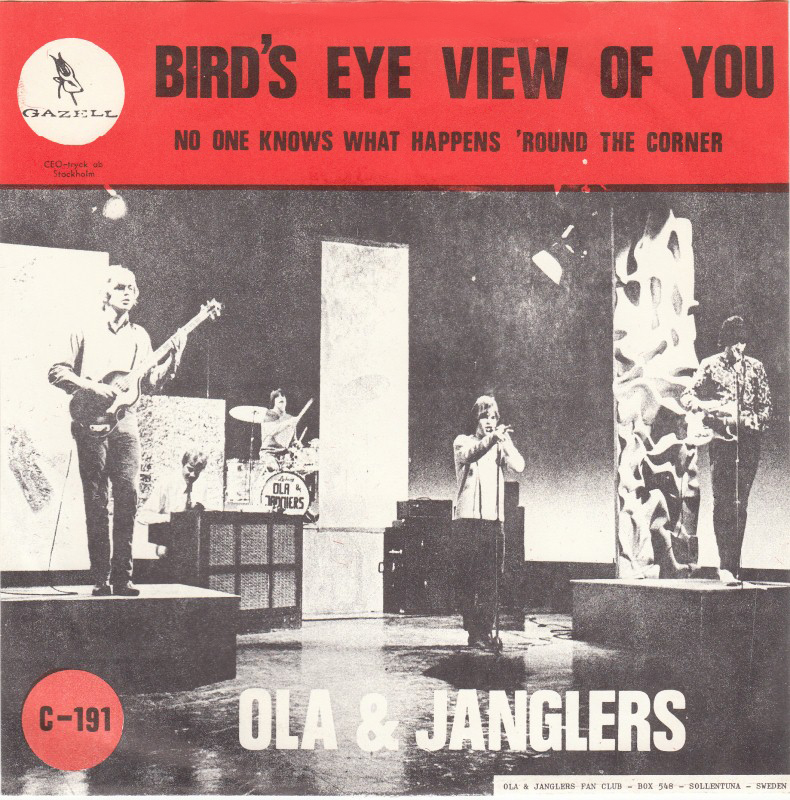
The same can be said about Ola & The Janglers. A graphic diagram of the quality of their output would look conspicuously similar to an ECG curve. Their bad songs were really bad and their good songs were really good. At their rawest they were a rather convincing garage rock band, and their stabs at psychedelia – most notably the Eastern-tinged track ”No One Knows What Happens Round the Corner” – were credible enough. Their good stuff would fill an LP length compilation, but a good one doesn't exist, only a couple focusing on their hits, including pointless Johnny-come-lately covers of Del Shannon's ”Runaway” and Chris Montez's ”Let's Dance”. I wish compilers would cast off the demon of nostalgia and go for the truly good stuff instead. There's one pretty great album hidden in Ola & The Janglers' ouvre but that has yet to see the light of day.

One of the Janglers' most prominent members, Claes af Geijerstam, recorded one underrated popsikey album in 1970, ”Out of My Hair”. The Ola of the bunch, Håkansson, went on to fame and fortune with bands like Secret Service who scored big with their single ”Oh Susie” in the 80's. He also became an influential music business honcho.

LEE KINGS

Lee Kings' output is relatively slim. Apart from a slew of singles it consists of one and a half LP only (the half one being shared with the forgettable band The Sunspots which contribute three tracks). Lee Kings were obviously sensitive to the changing times, constantly trying to come up with a song that would sit particularly well with the adolescent record buyers. You can easily say their vision, if ever they had one, was shaped by the whims of Tio i topp. That said, they did put out some memorable tracks, especially when psychedelia was slowly becoming the new worldwide fad. From Lee Kings' last year in existence, 1967, it's well worth lending an ear to ”Coming from the Ground” (backed by a surprisingly rowdy and fuzz fuelled "Day Tripper") and the highly endearing "The Trees Are Talking".

Singer Lenne Broberg later scored a brontosaurus sized hit with ”Mälarö kyrka”, a soft sounding predecessor of sorts to Contact's ”Fyrvaktarens dotter” and something of a 'guilty pleasure' of mine. And of course: guitarist Bengan Dahlén went to Fläsket Brinner.

STEAMPACKET
Steampacket, a.k.a. Steampacket II, a.k.a. The Longboatmen were also stylistic grasshoppers, even more so than Lee Kings. Their eight 45's present a wide array of styles, from the moody balladry of ”Bara ett par dar” to the fiery freakbeat of ”Take Her Any Time”, with stops at psychedelia, country music and straightforward pop along the way. But with the great Rolf Scherrer and the exceptionally talented Mikael Ramel (both vocals and guitar) in the band, they were well equipped to dabble in whatever they felt like. Their complete recordings were released on the print-on-demand CD ”The Singles and More 1965-68” in 2015, and although it's far from stylistically lucid there's certainly not much to object to as far as quality goes. Having already mentioned Scherrer and Ramel, it's obvious why Steampacket are crucial to the pre-history of progg. Scherer was an early member of Kebnekajse and can also be heard on several Bo Hansson albums. And Mikael Ramel – well, he's Mikael Ramel, i.e. a genius solo artist of ”Till dej” et al fame, plus a one-time member of Fläsket Brinner.

So what about their multiple band names? Well, in Sweden they were called Steampacket II for their first three singles to avoid being confused with Rod Stewart's band Steampacket. For the same reason, ”Take Her Anytime” was released in the UK as The Longboatmen. Later they were domestically known simply as Steampacket.

SHAKERS

Say what you will of Tommy Rander – later to become main leftwing fundamentalist operator on Gothenburg's progg scene and eventually the nemesis and relentless decapitator of progg's unkempt creativity, and recently taking an unnerving turn towards ideas sampled from the extreme rightwing (after all, politics aren't a linear scale but a circle where the extreme right and the extreme left are much closer neighbours than a lot of people have the guts to admit) – but he indeed had a strong vision of what Shakers were supposed to be. More precisely a snotty Rolling Stones/Pretty Things styled, abrasive rhythm & blues band. If you don't mind his fonetical gibberish (English in Rander's mind) on early tracks and only slightly bettered in time for the band's final releases, you have quite a few highlights to discover. Shakers were also one of the earliest and most eager condoners of psychedelia, as evident on excellent numbers such as ”Who Will Buy (These Wonderful Evils)” and ”Tracks Remain”. All their recordings are decidedly rough-hewn which is a welcome change of pace after delving into the discographies of the more polite sounding bands. And if you pretend there's no Rander involvement whatsoever, it gets even better...

NAMELOSERS

In terms of rawness, Malmö's Namelosers gave Shakers a run for their money. Few Swedish 60's singles rock as hard and brutal as Namelosers' throat-grabbing rendition of ”Land of a 1000 Dances”. Of all the recorded versions of that old chestnut, Namelosers' version is hands down among the top 3. I mean, seriously, that fuzz guitar can simply melt concrete walls! It's hard to fathom the fact it was recorded and released in Sweden as early as 1965 when fuzz boxes were a brand new thing only just heard on Rolling Stones and Beatles records. Namelosers were truly in with the in-crowd.

Founded already in 1962 as Tony Lee & The Fenders, they soon changed their name to The Beatchers. As such they released their debut EP in late 1964 with Gary U.S. Bonds cover ”New Orleans” as the lead track. A Gothenburg band called The Beachers, without a 'T' in the middle, wasn't too happy having another similarly named band around, and threatened The Beatchers, with a 'T' in the middle, with a lawsuit. The now nameless band needed to come up with something catchy to call themselves, and a name contest was arranged by pirate radio station Radio Syd. I've no idea what other listener suggestions there might have been, but whoever came up with Namelosers (with an obvious reference to the recent Beachers debacle) won... ”New Orleans” was hastily reissued (on a new label) with the substituted band name on the cover. The name mess proved advantageous however, bringing a fair amount of attention to the band, and the song went straight to No. 3 on the Tio i topp chart. Fans were frantic, causing havoc at Namelosers shows, and the band quickly earned a bad boys reputation, Rolling Stones style. Restaurants wouldn't let them in because of their long hair and scruffy looks. (Those were the days...) To further nurture their hoodlum image, they told Bildjournalen that one of their favourite pastimes was to go to Malmö's local dump and shoot rats. Probably nothing more than a publicity stunt, although their best singles indeed sound as if they could kill a diversity of rodents...

Namelosers released a total of fourteen tracks from 1964 to December 1965. One further song appeared on a Bildjournalen flexi disc in 1966, the storming ”Do-Ao”. For some odd reason, the impossible-to-overrate ”Land of a 1000 Dances” failed to enter Tio i topp. Taken by surprise and hugely disappointed, Namelosers called it quits shortly after. In 1989, rare records shop and record label Got To Hurry issued a compilation of Namelosers complete studio recordings. Still possible to locate in used condition, a reissue is nevertheless long overdue.

ANNAABEE-NOX

In the small but loud legion of more garage infused bands you can't ignore the curiously spelled Annaabee-Nox. As with Shakers, no label trusted them with an album contract. Seven singles and a track on a Bildjournalen flexi disc are all that officially remain from their 1965-1968 lifespan. A rare surviving live tape confirms what people lucky enough to have seen them in concert have said ever since: they were one wild stage act. Not all of their studio recordings retain that same high level fervor, but you really don't want to mess with ”I'm Not Talking” and ”Bo Bo Boggie Pack” [sic!] if you love your mother. If you love your wife/husband and yourself, you don't want to pay the prices for the original 45's either – if they ever appear in playable condition that is. Thankfully, their complete discography received the compilation treatment in 2014 by Allatiders Skivhandel, and it's also easily obtainable in digital format courtesy of Parlophone.

LEA RIDERS GROUP

Of all 60's bands, Lea Riders Group is probably the one that most notably bridges the 60's and the progg era. They were also one of the most technically mature rock bands Sweden spawned during the entire decade. Led by Hawkey Franzén and featuring Slim Borgudd and Bosse Häggström, they were the embryo of Made In Sweden. Without Jojje Wadenius, the jazz elements were a lot fewer, although you could still hear jazz strains in their best known track ”Dom kallar oss mods” (the leitmotif from Stefan Jarl's [semi-]documentary of the same name). Without a doubt the band's high point, with wild screeching guitars, frenetic staccato vocals dissolving into stoned and paranoid groans, drums pounding out a disintegrating beat that is hazy and hard as rebar at the same time, a full frontal psychedelic assault leaving only smoke and dead bodies behind. A lot of people are familiar with it from being famously included on ”Pebbles Volume 3” (and subsequently on other comps as well). A track like that obviously raises the expectations for Lea Riders Group's other outpourings, but they might leave you disappointed at first. Which is not to say that the rest of their material is bad. Not at all. On the contrary, a lot of it is hard-boiled, thick-skinned, jailhouse badass rhythm & blues of international stature with all the chops needed to pull it off with brilliant precision. Just not from the same mould as ”Dom kallar oss mods”.

For an annoyingly long time, Lea Riders Group's recordings were just about impossible to find. Swedish label Garageland Records tried to rectify that in the late 80's when they released a vinyl comp, later reissued on CD as ”The Forgotten Generation”. However, the Garageland CD is best forgotten too as the sound is so dull and hissy that I suspect the tracks were taken from a fourth or fifth generation cassette dub. That hack job was thoroughly pushed into the depths of redundancy when Universal (for once!) did a good thing and released the collected singles on a Record Store Day LP in 2018. Although losing the bonuses from the Garageland CD (all of them live recordings and/or rehearsals in dubious fidelity from what I recall) and not including the additional instrumental tracks from the soundtrack to Jarl's movie, Universal's ”The Singles 1966-68” is absolutely essential from any perspective.

FRIENDS

When Garageland put out the unsatisfactory ”Forgotten Generation” CD, they concurrently reissued two other titles from their back catalogue, one by Panthers, and one by the rather peculiar band Friends. The Panthers release is best ignored altogether, but the Friends CD ”Talkin' 'bout Us” is well worthy of attention. At least to some. They're probably a band in the 'love it or hate it' category, all depending on what you think of Anders Peedú's vocals which admittedly is an acquired taste. The pronunciation heard on the early Shakers singles is Queen's English compared to the sometimes indecipherable syllables coming out of Peedú's mouth. But if that doesn't bother you (and I've learnt not to let it bother me although it took some time and persistance), then Friends were a rather remarkable group who despised the commonly overt Beatles and Stones influences. Their take on rhythm & blues was quite frankly unique among Swedish bands. ”It Ain't Necessarily So” and ”Empty Handed”, both taken from Friends' 1965 debut 45, are as raw as any of the American garage bands, untrained to the nth degree but nevertheless consistent and chock-full of self-assured and cocky attitude bordering on the nihilistic. Despite all Friends' obvious shortcomings (like having a twelve year old drummer, but so did Ornette Coleman), the three singles released during their short lifetime as a band are some rather exceptional stuff. The Garageland album fleshes out the short playing time those singles make for with some previously unreleased tapes which add nicely to the dizzying experience.

Although having Karusell, a major label with a thorough experience of bringing fame to their acts, backing them, nothing could catapult Friends to the commercially viable level of Tages, Mascots and Shanes. An appearance on the biggest (actually, only) TV talk show Hylands hörna generated gigs but no impressive record sales. Friends' fan base was largely made up of outcasts and mods from Stockholm's underground circuits, people often sharing the hard-living Friends' destructive lifestyle of drugs and alcohol. Years after the demise of the band – it was all over in 1966 – two of the members died from substance abuse. A unique band with an ever so inspiring integrity, but with a tragic story attached to it.

HEP STARS

I've not yet mentioned the biggest act of all: Hep Stars. Still heralded among a lot of people, I refuse to believe their position in people's minds is anything but pure nostalgia. Because man, did they suck! The only thing worthy of acknowledgement is their smash hit cover of Vince Taylor's ”Cadillac” which remains a stone cold classic. Albumwise, the only remotely amusing thing they did was the undeniably frantic live document ”On Stage” where they rush through their repertoire at breakneck speed in front of hysterical teenage girls. It's not a good album by any stretch, but yeah, it is remotely amusing. Hep Stars member Benny Andersson later became a mega star with ABBA.

COMPILATIONS

There are several shortcuts to the Swedish 60's if you don't want to take the long and often disappointing road to it. For a general overview there are two vastly different editions of ”Stora popboxen”. The first one leans towards the poppier side, while the second edition is more towards the rhythm & blues sounds. Both of them are a bit much to chew for the average listener, why I'd rather recommend the almost flawless one disc comp ”Searching for Shakes”. Originally released on vinyl by Amigo Records in the mid 80's, the CD reissue is graciously expanded with meticulously chosen tracks in the same garage/freakbeat vein as the original album. Some of the songs I've specifically mentioned above are featured on this five star compendium of Sweden's rawest sounds from the 60's. A similarly styled 2 CD set was fairly recently put together by UK's RPM Records, entitled ”Svenska Shakers”, accurately subtitled "R&B crunchers, Mod grooves, Freakbeat and Psych-pop from Sweden 1964-1968". There's some overlap with ”Searching for Shakes”, but the RPM release has several hard-to-find nuggets not on the Amigo artefact and vice versa, so if you like one of them, chances are you'll want the other one as well. The RPM set looks pretty nice too.


There are several minor acts that released utterly mindblowing one-off singles that are very rare and seldom comped. The six-volume series ”Who Will Buy These Wonderful Evils” does a brilliant job bringing several more psychedelic sides together. Well-known bands such as Tages, Shanes, Ola & The Janglers and Mascots rub shoulders with more obscure acts like The Outsiders ("On My Magic Carpet" is a killer track!), T-Boones (featuring a very young Kenny Håkansson, as on the devastating "I Want You"), the garage punk of The Other Side's "Out My Light", the brilliant Members Blues Band (whose ”P.S. Elic” is quite possibly the trippiest single ever released in Sweden), New Creation (Christian outfit whose ”He Is There” is a jawdropping slice of proto-progressive late night psych), The Junk's & The Angels, Älgarna etc etc etc. Reaching into the 70's, the ”Who Will Buy These Wonderful Evils” volumes are mandatory to readers of this blog. I'm not sure of their current availability but I assure you it's worth some effort to track them down, the first four volumes in particular.